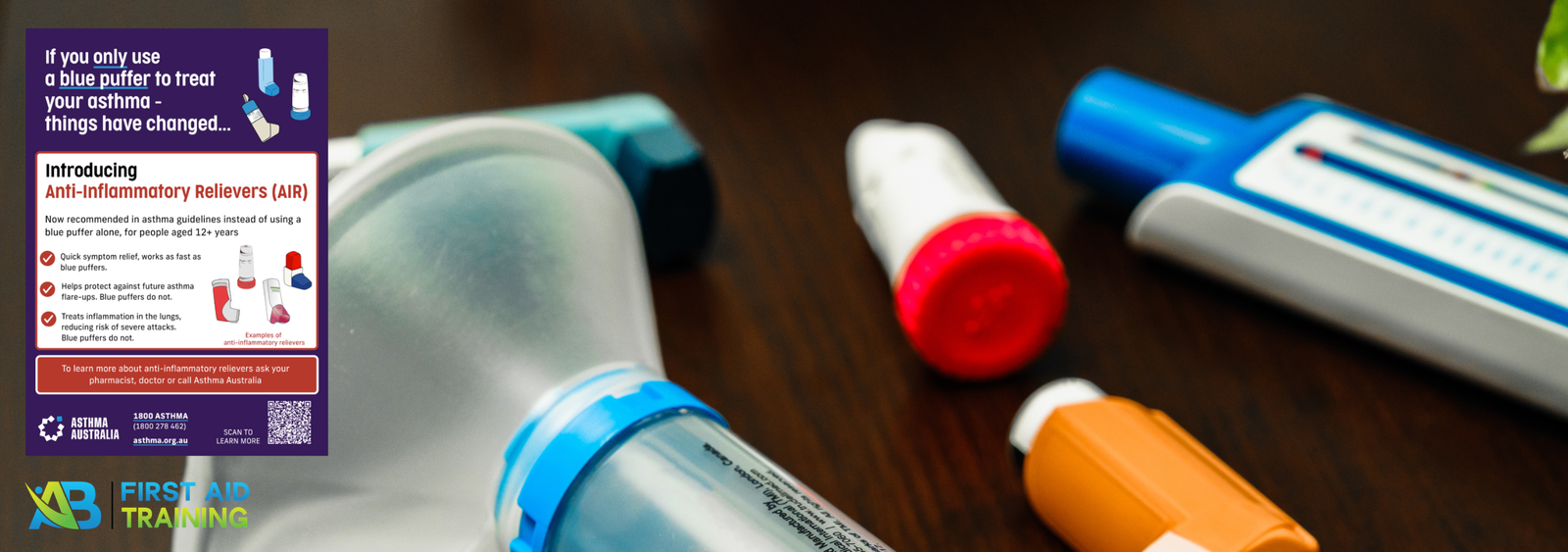
Australia’s asthma guidelines have changed. Learn what AIR therapy means and why blue puffers alone are no longer recommended for many people.
Treating Electrical Burns on the Worksite: A Step-by-Step First Aid Guide for Electricians
Australia’s asthma guidelines have changed. Learn what AIR therapy means and why blue puffers alone are no longer recommended for many people.
Practical First Aid Skills Every NDIS Support Worker Needs to Know
Australia’s asthma guidelines have changed. Learn what AIR therapy means and why blue puffers alone are no longer recommended for many people.
First Aid Requirements for Victorian Schools: What the Law Actually Requires
Australia’s asthma guidelines have changed. Learn what AIR therapy means and why blue puffers alone are no longer recommended for many people.
The Most Common First Aid Hazards on Electrical Worksites
Australia’s asthma guidelines have changed. Learn what AIR therapy means and why blue puffers alone are no longer recommended for many people.
First Aid Compliance in Childcare: What ACECQA and Victorian Regulations Actually Require
Australia’s asthma guidelines have changed. Learn what AIR therapy means and why blue puffers alone are no longer recommended for many people.
Common First Aid Myths Electrical Workers Should Stop Believing
Common First Aid Myths NDIS Support Workers Should Stop Believing
Australia’s asthma guidelines have changed. Learn what AIR therapy means and why blue puffers alone are no longer recommended for many people.
What to Do When a Student Has a Seizure: A Practical Guide for School Staff
Australia’s asthma guidelines have changed. Learn what AIR therapy means and why blue puffers alone are no longer recommended for many people.
Common First Aid Myths Childcare Workers Should Stop Believing
Published by AB First Aid — nationally registered first aid training provider, Tullamarine, Victoria. First aid advice spreads fast in childcare settings — through staff rooms, Facebook groups, and half-remembered training sessions. Some of it is solid. A lot of it isn’t. When it comes to real emergencies involving children, acting on outdated or incorrect information doesn’t just slow you down — it can make things worse. Here are some of the most common first aid myths circulating in early childhood settings, and what the evidence and Australian guidelines actually say. Do You Need to Tilt the Head Back When a Child Is Choking? No — tilting the head back is not recommended for a choking child, and doing so can actually push an obstruction further into the airway. The correct response for a conscious child who is choking is to give up to five back blows between the shoulder blades, followed by up to five chest thrusts. For infants under twelve months, the technique differs: use a combination of back blows and chest thrusts, and never perform abdominal thrusts (the Heimlich manoeuvre) on a baby. These guidelines come from the Australian Resuscitation Council (ARC), which sets the evidence-based standard for resuscitation training in Australia. Myth: You Should Put Butter or Oil on a Burn Putting butter, oil, toothpaste, or any other home remedy on a burn is one of the most persistent myths in first aid — and one of the most harmful. These substances trap heat in the skin, increasing tissue damage and raising the risk of infection. The correct response, as outlined by the ARC and Kidsafe Australia, is cool running water for a minimum of 20 minutes. The water should be cool, not cold or iced, to avoid causing shock or hypothermia in young children. Remove any clothing or jewellery near the burn, but do not peel away anything that is stuck to the skin. This applies to childcare settings too. If a child in your care sustains a burn, start the cooling process immediately while calling for emergency assistance if the burn is larger than a 20-cent piece, on the face or hands, or involves a very young child. Does Putting a Child in the Recovery Position Mean They Are Safe? The recovery position reduces the risk of airway blockage in an unconscious child who is breathing — but placing a child on their side is not the end of your responsibilities. You still need to monitor breathing continuously, ensure emergency services have been called, and be prepared to begin CPR if breathing stops. The recovery position is a management step, not a resolution. A child who is unconscious and breathing still requires urgent medical attention, regardless of how stable they appear in the moment. Myth: Childhood CPR Is the Same as Adult CPR The principles of CPR — compressions and breaths to restore circulation — are the same, but the technique changes significantly depending on the child’s age. For children aged one to eight years, the Australian Resuscitation Council recommends using one or two hands for chest compressions, pressing down approximately one-third of the chest depth. For infants under twelve months, use two fingers on the centre of the chest. Compression ratios and breath volumes also differ. Using adult CPR technique on a young child can cause injury, and being unfamiliar with the differences wastes critical time during an emergency. Under the Education and Care Services National Regulations, childcare services in Victoria are required to have at least one staff member with a current approved first aid qualification present at all times — including a Provide First Aid certificate and CPR training renewed annually. This requirement exists precisely because the skills needed in a childcare setting are specific, not just general adult first aid knowledge. What Should You Actually Do for a Child Having a Febrile Seizure? Febrile seizures — seizures triggered by a rapid rise in body temperature — are one of the more frightening events a childcare worker can witness, and they come with plenty of misinformation attached. The most common myths: hold the child down to stop them shaking, put something in their mouth to prevent biting, or cool them with a cold wet cloth to bring the fever down during the seizure. None of these are correct. You should not restrain the child, put anything in their mouth, or apply cold to the body during an active seizure. The correct response is to clear the area of any hazards, gently guide the child to the ground if they are upright, place them on their side, time the seizure, and call 000 if the seizure lasts more than five minutes, if this is a first febrile seizure, or if you are unsure. After the seizure ends, place the child in the recovery position, keep them warm, and wait for medical help. Always notify parents and document the event in your service’s incident register. Myth: Any Staff Member Can Give Medication to a Child in an Emergency Administering any medication to a child in a childcare setting requires a completed medication authorisation form signed by a parent or guardian — not a verbal instruction, a text message, or an assumption based on familiarity. Administering unprescribed medication without written authorisation is a breach of the Education and Care Services National Regulations. Services in Victoria are required to follow the National Quality Framework and maintain a medication administration register for every dose given. The exception is emergency situations involving anaphylaxis or asthma, where staff trained in anaphylaxis or emergency asthma management may administer an adrenaline auto-injector or reliever inhaler according to an individual medical management plan — even without prior written consent. For all other medication, written authorisation is required before a single dose. Why Getting Your First Aid Knowledge Right Matters In any given week, a childcare worker might manage scraped knees, allergic reactions, bumped heads, and choking scares. The difference between a confident, informed response and a well-meaning but incorrect one