If you manage first aid across a school, childcare service, disability or aged care setting, anaphylaxis is one of those risks you cannot “set and forget”. The devices change, supply can change, and the consequences of confusion in an emergency can be serious.
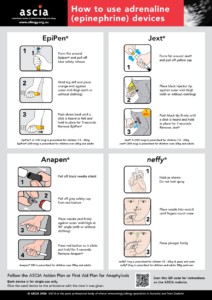
Australia now has two newly TGA-registered adrenaline (epinephrine) options on the horizon: Jext (a new auto-injector) and neffy (a needle-free nasal spray). At the same time, Anapen supply has shifted significantly, including discontinuation of the 150 microgram and 300 microgram devices, and later supply disruption and discontinuation notices for Anapen 500.
This article breaks down what’s changing, how Jext and neffy compare with EpiPen, and what organisations should do now to reduce risk and keep staff confident.
Why this matters (and what’s at stake)
Best-practice anaphylaxis response is fast and simple: recognise symptoms, give adrenaline, call an ambulance, follow the ASCIA plan, and be ready to give another dose if needed after 5 minutes.
But on the ground, real life gets messy:
- People freeze when the device looks unfamiliar
- Devices have different steps and different dose ranges
- Staff turnover means “trained last year” can quickly become “not confident today”
- Supply changes can force substitutions at pharmacy level, increasing device variety in your community
For schools and care services, this becomes a systems problem, not just an individual training problem. You need consistent processes, refreshers, and device-specific competency.
The problem: where organisations get caught out
Across workplaces and education/care settings, the common pain points are predictable:
- One brand is used in training, but another brand is on-site (or brought in by families)
- People do not realise devices differ in “how to use”, not just in name
- General-use device decisions are made without considering what the community actually carries
- Expiry management is inconsistent, especially when multiple devices are stored across sites
- Action plans are present, but staff do not practise the physical steps regularly
And in a severe allergic reaction, delays matter. ASCIA is clear that anaphylaxis is a medical emergency and adrenaline should be given immediately.
What good looks like (ideal practice)
A best-practice anaphylaxis readiness system usually includes:
- A clear, organisation-wide standard aligned to ASCIA Action Plans
- Device-aware training that covers the actual devices people use (and might bring on-site)
- Short, frequent refreshers that keep muscle memory strong
- A documented approach to storage, access, signage, and checks (including expiry)
- Clear escalation steps: give adrenaline, call 000, lay flat, monitor, second dose after 5 minutes if no response, transfer to hospital for observation
That “device-aware” point is exactly why Jext and Neffy matter.
What’s new: Neffy nasal spray (needle-free adrenaline)
Neffy is an adrenaline (epinephrine) nasal spray device, registered on the Australian Register of Therapeutic Goods (ARTG) on 8 December 2025, in two strengths:
- Neffy 2 mg (ARTG 470025)
- Neffy 1 mg (ARTG 469945)
ASCIA’s update notes key Australia-specific points:
- Expected to be available in Australia in 2026 (timing still being confirmed)
- Not currently available for over-the-counter purchase
- Not yet listed on the PBS
Dose and patient suitability (as described by ASCIA and Allergy & Anaphylaxis Australia resources):
- Neffy 1 mg: children aged 4 years and over, 15 kg to less than 30 kg
- Neffy 2 mg: 30 kg and over
Why Neffy may change training conversations
A needle-free option may help in situations where needle fear is a barrier to prompt treatment, or where bystanders hesitate. Some Australian clinical commentary has described it as a “needle-free” anaphylaxis treatment option following TGA approval/registration.
Important practical note for organisations: Neffy does not remove the need for an ASCIA Action Plan, calling 000, and escalation if symptoms do not improve.
What’s new: Jext adrenaline auto-injector (new to Australia)
Jext is a new adrenaline injector option for Australia, with two TGA-registered devices:
- Jext 300 microgram (ARTG 401801) registered 14 November 2025
- Jext Jnr 150 microgram (ARTG 401800) registered 14 November 2025
ASCIA has stated Jext devices are expected to be available in Australia in 2026, alongside EpiPen and neffy.
How Jext compares with EpiPen (in a practical, training sense)
From a workplace readiness perspective, the biggest difference is not the medication (all deliver adrenaline/epinephrine), but the device steps and the “what people are used to”.
Dose options and typical weight guidance
Current commonly referenced guidance in Australia includes:
- EpiPen Jr 150 microgram: 7.5–20 kg
- EpiPen 300 microgram: over 20 kg
ASCIA’s current prescribing guidance also lists:
- Jext Jnr 150 microgram as an option in the 7.5–20 kg range
- Jext 300 microgram as an option for over 20 kg
Key point: your community may soon have EpiPen, Jext, and neffy in circulation at the same time. That increases the need for device-specific training and visual prompts.
EpiPen access and general-use considerations
Education settings often maintain general-use adrenaline auto-injectors. For example, Victorian Department of Education guidance notes that adrenaline autoinjectors for general use can be purchased from a chemist without a prescription (with schools purchasing at their own expense), and leaders need to decide which type to purchase.
As more brands enter the market, “which type to purchase” becomes a more important decision, because it influences training, posters, refreshers, and incident response consistency.
Anapen: what’s been discontinued (and what happened with Anapen 500)
Anapen has had multiple major changes in Australia, and it is worth stating the dates clearly because many people have heard different versions.
Anapen Junior 150 and Anapen 300 discontinued in Australia (2024)
Allergy & Anaphylaxis Australia reported that Arrotex advised:
- Anapen 300 available until end of July 2024
- Anapen Junior 150 available until end of September 2024
- After these dates, pharmacies could substitute EpiPen or EpiPen Jr and provide training on device use
ASCIA also stated the decision to discontinue Anapen Junior 150 and Anapen 300 was due to lack of demand for a second brand at those strengths, and was not related to quality, safety, or efficacy issues.
Anapen 500: out of stock and discontinuation notice (2025)
A July 2025 product update letter regarding Anapen 500 stated it was out of stock in Australia due to an “unresolvable global supply shortage”, and the FAQ section states Anapen 500 is being discontinued in Australia due to that supply shortage (not due to safety, efficacy, or quality concerns). It also states it would no longer be available for distribution after 30 June 2025, with pharmacy stock lasting until exhausted.
The same letter notes there was no direct 500 microgram auto-injector equivalent available in Australia at that time, and lists EpiPen 300 and EpiPen Jr as alternatives to discuss with a doctor/allergist.
Practical implication: if your organisation historically trained staff on Anapen steps, you need to actively manage the transition. In the short term, it may mean more EpiPen in circulation, and from 2026, potentially more Jext and neffy too.
How AB First Aid helps (without adding complexity)
In multi-site organisations, the goal is confidence under pressure, even when devices vary. AB First Aid supports teams by making anaphylaxis readiness practical and repeatable:
- Training that aligns to ASCIA Action Plans and first aid guidance
- Device-aware education so staff know the differences (and practise the physical steps)
- Support for general-use device planning, signage, and location standards
- Refresher rhythms that suit busy rosters (so skill fade does not become your hidden risk)
The key is reducing variation in how your team responds, even if the devices vary.
Practical checklist: what to do now (before Jext and neffy are common on-site)
Use this as a quick internal audit.
Map what devices your community actually has
- Ask families/clients/staff what they carry (EpiPen, Anapen, others)
- Check what your organisation stocks as general-use
Update training to match reality
- Ensure training covers the devices you will realistically see
- Include “what changes between devices” as a standard part of refreshers
Tighten your emergency flow (ASCIA-aligned)
- Lay flat, do not allow standing/walking
- Give adrenaline immediately
- Call 000
- If no response after 5 minutes and another dose is available, give further adrenaline
- Transfer to hospital for observation
Strengthen visual prompts
- Place the ASCIA Action Plan where devices are stored
- Add device-specific “how to use” prompts if multiple brands are present
Plan for 2026 device variety
Anticipate neffy and Jext availability in 2026 and decide how you will handle:
- induction training
- refresher training
- general-use purchasing decisions
References and resources
Primary Sources on New Devices
ASCIA – Two new adrenaline (epinephrine) devices are TGA registered
https://www.allergy.org.au/about-ascia/info-updates/two-new-adrenaline-epinephrine-devices-are-tga-registeredAllergy & Anaphylaxis Australia – neffy adrenaline nasal spray update
https://allergyfacts.org.au/news/neffy-adrenaline-epinephrine-nasal-spray/Therapeutic Goods Administration (TGA) – neffy 2 mg (ARTG 470025)
https://www.tga.gov.au/resources/artg/470025Therapeutic Goods Administration (TGA) – neffy 1 mg (ARTG 469945)
https://www.tga.gov.au/resources/artg/469945Therapeutic Goods Administration (TGA) – Jext 300 microgram (ARTG 401801)
https://www.tga.gov.au/resources/artg/401801Therapeutic Goods Administration (TGA) – Jext Jnr 150 microgram (ARTG 401800)
https://www.tga.gov.au/resources/artg/401800Anapen Discontinuation and Supply Updates
Allergy & Anaphylaxis Australia – Important Anapen update (150 and 300 discontinued)
https://allergyfacts.org.au/news/important-anapen-update-supply-information/ASCIA – Product update: Anapen injector devices
https://www.allergy.org.au/about-ascia/info-updates/product-update-anapen-r-adrenaline-injector-devicesASCIA – Anapen 500 supply update (July 2025 letter PDF)
https://www.allergy.org.au/images/2025_anapen_500_supply_update_July_2025_Final.pdfClinical Guidance and Action Plans
ASCIA – First Aid for Anaphylaxis
https://www.allergy.org.au/hp/anaphylaxis/first-aid-for-anaphylaxisASCIA – Action Plan for Anaphylaxis (General)
https://www.allergy.org.au/images/stories/anaphylaxis/2026/ASCIA_Action_Plan_Anaphylaxis_General_2pg.pdfASCIA – Adrenaline Device Prescription Guidelines (2026 update)
https://www.allergy.org.au/images/stories/anaphylaxis/2025/ASCIA_HP_Guidelines_Adrenaline_Device_Prescription_2026.pdfAdditional Context
Victorian Department of Education – Adrenaline autoinjectors for general use
https://www2.education.vic.gov.au/pal/anaphylaxis/guidance/10-adrenaline-autoinjectors-general-useRACGP – TGA approves needle-free anaphylaxis treatment
https://www1.racgp.org.au/newsgp/clinical/tga-approves-needle-free-anaphylaxis-treatmentHealthdirect – Anaphylaxis information
https://www.healthdirect.gov.au/anaphylaxis

Book A Course
Recent Blogs
- All Posts
- Compliance
- First Aid

If you have ever heard someone say “Yeah, I’ve got my LVR somewhere” and then watched the panic set in...

Learn what electrical duty of care means under Australian WHS laws, who is responsible, and how to meet obligations with...

How often must electricians renew LVR in Australia? The 12-month rule explained, CPR requirements, WA licensing nuance, and audit-ready compliance...
AB First Aid Training & Compliance
Ask Us About Our Full Service Compliance & Safety Package
FREE When You Partner With Us!
Have You Read These Articals Yet?
- All Posts
- Compliance
- First Aid

If you have ever heard someone say “Yeah, I’ve got my LVR somewhere” and then watched the panic set in...

Learn what electrical duty of care means under Australian WHS laws, who is responsible, and how to meet obligations with...

How often must electricians renew LVR in Australia? The 12-month rule explained, CPR requirements, WA licensing nuance, and audit-ready compliance...