
It starts like any ordinary Tuesday.
You’re supporting a participant in their home — a 38-year-old man with an intellectual disability who lives independently with daily check-ins. He’s at the kitchen table eating lunch while you finish documenting the morning’s support notes. Then you hear it: a sharp, sudden silence where there should be chewing and conversation.
You look up. He’s gripping the edge of the table, eyes wide, not making a sound. His face is beginning to flush.
This is choking. And what you do in the next 60 seconds matters more than almost anything else you will do in your career as a support worker.
Why Choking Is a Serious Risk in NDIS Settings
Choking is one of the most preventable causes of sudden death in Australia, and support workers are statistically more likely to witness it than most other workers. Clients living with intellectual disabilities, acquired brain injuries, cerebral palsy, or neurological conditions often experience difficulty with swallowing — a condition known as dysphagia.
According to clinical practice guidelines cited by the NDIS Quality and Safeguards Commission, people with certain disabilities have significantly elevated rates of swallowing difficulties compared to the general population. This means that for NDIS support workers, the question isn’t if you will encounter a choking emergency — it’s when.
The first priority when any client shows signs of choking is to assess whether they can cough. If they are coughing forcefully, encourage them to keep coughing. A strong cough is the most effective way to clear an airway obstruction. Do not intervene physically unless the cough becomes weak, stops, or the person cannot speak or breathe.
Back to That Tuesday: What Happens Next
Your client cannot cough. He’s making high-pitched sounds — sometimes called stridor — and his skin is becoming mottled around the lips. That’s a clear sign of a partial or complete airway obstruction.
You act immediately.
Step 1: Call for help. If someone else is in the home, shout for them now. Call Triple Zero (000) if the situation does not resolve in the next few seconds. Do not delay calling — you can perform first aid while waiting for the ambulance.
Step 2: Encourage leaning forward. Ask your client to lean forward over the table or your arm. Gravity assists in dislodging the obstruction.
Step 3: Deliver five firm back blows. Using the heel of your hand, strike firmly between the shoulder blades five times. Each blow should be distinct and forceful — not a pat. The goal is to create a sharp pressure change in the airway to dislodge the obstruction.
Step 4: Check the mouth. Look in the mouth only if you can clearly see an object. Never perform a blind finger sweep — this can push the obstruction deeper.
Step 5: Five abdominal thrusts. If back blows don’t work, move to abdominal thrusts (the Heimlich manoeuvre). Stand behind your client, place one fist above the navel and below the sternum, wrap your other hand around it, and thrust firmly inward and upward five times.
Continue alternating five back blows with five abdominal thrusts until the obstruction is cleared, the person loses consciousness, or paramedics arrive.
In our scenario, the third round of back blows dislodges a piece of food. Your client gasps, draws a breath, and starts coughing. His colour begins to return.
You call 000 anyway — because he needs to be assessed by paramedics, even if the immediate danger has passed.
If Your Client Becomes Unconscious
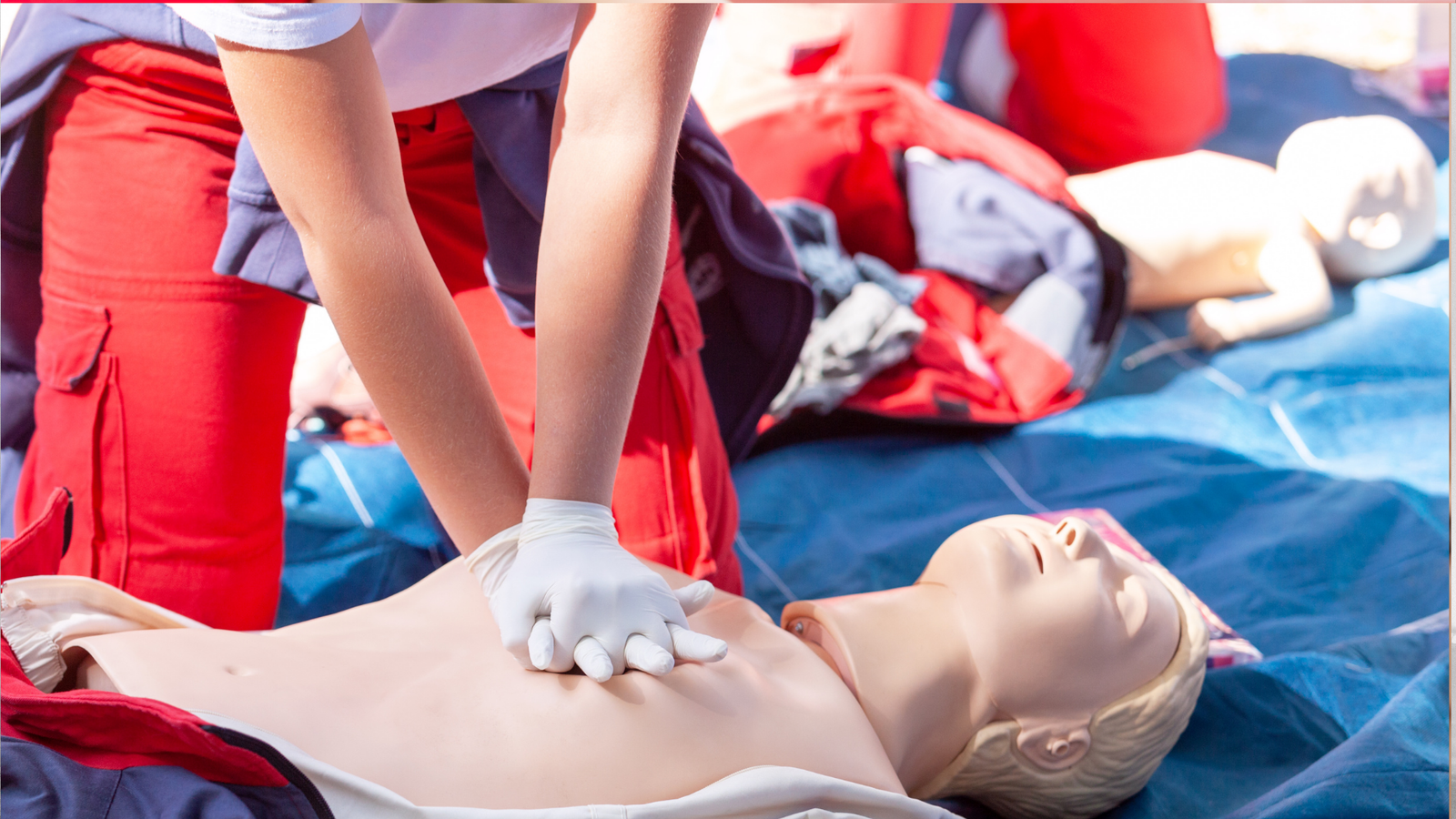
If at any point your client loses consciousness and stops breathing normally, the situation becomes a cardiac arrest. Lower them carefully to the ground, call 000 immediately if you haven’t already, and begin CPR.
The Australian Resuscitation Council (ARC) guidelines recommend 30 chest compressions followed by 2 rescue breaths, repeated until help arrives or the person begins to breathe. If you’re not confident with rescue breaths, hands-only CPR (compressions only) is still significantly better than no CPR at all.
ARC guidelines are regularly updated and are freely available at resus.org.au. They are the national standard that all first aid training in Australia must align with.
Modified Technique for Clients Who Use Wheelchairs
If your client uses a wheelchair and cannot stand or lean forward easily, the abdominal thrust technique needs to be adapted. Position yourself behind the wheelchair, reach around the client’s body, and perform the thrusts from behind, keeping the chair stable. For clients in powered or bariatric chairs, knowing your client’s mobility and physical profile in advance is critical — this is something worth discussing in care planning and practising in your training.
The NDIS Practice Standards (specifically Outcome 2.5 on emergency and disaster management) require that support workers are trained and competent to respond to emergencies. That explicitly includes first aid. But “trained” means more than knowing the theory — it means you can actually do it when your hands are shaking and someone’s life depends on it.
What This Scenario Teaches Us
A few things stand out from this example beyond the immediate mechanics of choking response.
Know your client’s swallowing profile. If a client has a swallowing assessment or modified diet plan, understand it and follow it consistently. Choking prevention is as important as the response itself. If a client has a known dysphagia risk, that information should be prominent in their support plan.
Don’t hesitate when the signs are clear. Support workers sometimes wait too long because they’re not sure if it’s “bad enough.” The rule is simple: if a person cannot speak, breathe, or cough effectively, act immediately.
Train regularly. First aid skills deteriorate without practice. WorkSafe Victoria and Safe Work Australia both recommend that workers in high-risk care environments maintain current first aid certification. The recommended minimum for most NDIS providers is a Provide First Aid (HLTAID011) certificate, renewed every three years, with CPR (HLTAID009) renewed annually.
Document the incident. After any emergency — even one that resolves quickly — complete an incident report as required by your organisation and the NDIS Quality and Safeguards Commission’s incident management requirements. This protects you, your client, and your organisation.
Be Ready Before It Happens
Real first aid skill comes from practice, not from reading a scenario. The situation described above plays out in under two minutes. You won’t have time to look up the steps.
If your first aid certificate has lapsed, or you’ve never completed formal training, now is the time to book. AB First Aid runs regular training sessions in Tullamarine for NDIS support workers, covering Provide First Aid (HLTAID011) and CPR refreshers in a practical, hands-on environment.
View the course schedule and enrol — because when someone needs you, you want to be ready.
References
- Australian Resuscitation Council (ARC). (2021). Guideline 4: Airway. resus.org.au
- NDIS Quality and Safeguards Commission. (2024). NDIS Practice Standards and Quality Indicators. ndiscommission.gov.au
- Safe Work Australia. (2023). First Aid in the Workplace: Code of Practice. safeworkaustralia.gov.au
- WorkSafe Victoria. (2023). Compliance Code: First Aid in the Workplace. worksafe.vic.gov.au
- Speech Pathology Australia. (2022). Dysphagia clinical guidelines. speechpathologyaustralia.org.au