Common First Aid Myths School Staff Should Stop Believing
First aid in schools carries a lot of received wisdom — advice passed down from previous staff, half-remembered training from years ago, or guidance that sounds sensible but isn’t backed by current evidence. The problem is that acting on outdated or incorrect information in an emergency can make things worse, not better.
Victorian school staff have a duty of care to their students, and part of meeting that duty is knowing what actually works — not just what feels right in the moment. Here are some of the most common first aid myths that still circulate in school settings, and what the correct response looks like.
Myth 1: Only the Designated First Aid Officer Can Respond
Many schools operate as though first aid is the sole responsibility of one or two nominated staff members. If the first aid officer is unavailable, the assumption is to wait.
This is wrong, and in a serious emergency, it could be dangerous. Under the Education and Training Reform Act 2006 and WorkSafe Victoria guidelines, schools must ensure adequate first aid is available at all times. Any trained staff member can and should provide first aid — not just the person with a formal appointment. The designated first aid officer is responsible for maintaining kits and records, but emergency response is everyone’s responsibility.
The key is training. Staff who hold a current first aid certificate — such as a Provide First Aid (HLTAID011) qualification — are equipped to act. Regular refreshers ensure that response is confident and correct when it counts.
Myth 2: Tilt the Head Back During a Nosebleed
This one is widespread and unfortunately wrong. Tilting the head back during a nosebleed causes blood to flow into the throat, where it can be swallowed, inhaled, or trigger nausea — particularly in young children.
The correct approach is to have the student lean slightly forward, pinch the soft part of the nose firmly, and breathe through the mouth. Hold pressure for at least 10 minutes without releasing to check. If bleeding does not stop after 20 minutes, or if it follows a head injury, seek medical attention.
Myth 3: Cool a Burn with Ice
Ice on a burn seems logical — it’s cold and it hurts, so cold must help. In fact, applying ice or iced water to a burn causes further tissue damage. Ice restricts blood flow to the area and can cause an ice burn on top of the original injury.
The correct burn first aid is to run cool (not cold) running water over the burn for a minimum of 20 minutes. This reduces heat in the tissue and limits the depth of the injury. Do not use butter, toothpaste, aloe vera, or any other home remedy. Remove clothing and jewellery from the area if safe to do so, and do not break any blisters.
This applies to burns from hot surfaces, liquids, and friction — all common in school settings, from science labs to technology classes to playground incidents.
Myth 4: Put Something in the Mouth of a Student Having a Seizure
The idea that a person can “swallow their tongue” during a seizure is medically inaccurate — it cannot happen. Despite this, the belief persists, and some staff still attempt to restrain students or place objects between their teeth during a convulsion.
This causes injury — to the student and to the person trying to help.
The correct first aid for a seizure in a school setting follows guidance from Epilepsy Australia:
- Stay calm and stay with the student
- Clear the area of hard or sharp objects
- Do not restrain the person
- Do not put anything in their mouth
- Time the seizure
- Once convulsions stop, place the student in the recovery position
- Call 000 if the seizure lasts more than five minutes, if another seizure follows quickly, or if the student does not regain consciousness
Schools should also follow any relevant Individual Health Care Plan (IHCP) or Student Support Group documentation for students with a known seizure history.
Myth 5: Asthma Is Always Obvious
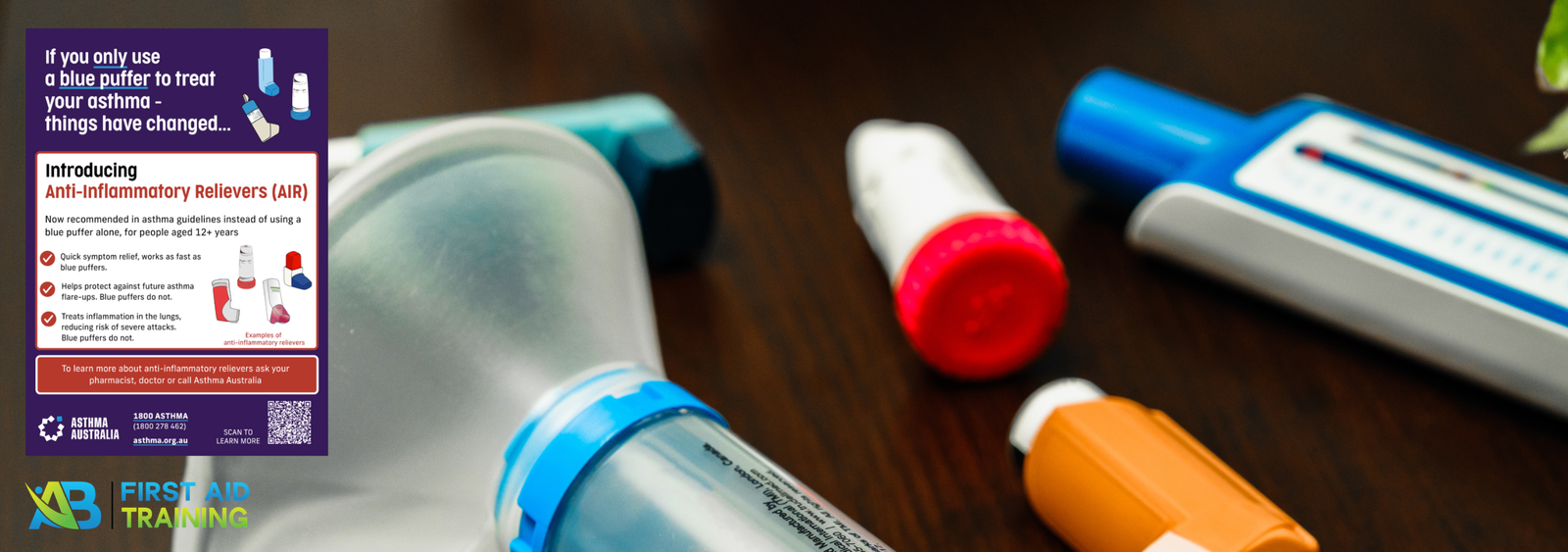
Wheezing is the classic sign of an asthma episode, but not all students wheeze — particularly in the early stages of an attack. Signs can include persistent coughing, tightening in the chest, difficulty speaking in full sentences, or distress during physical activity.
Victorian schools must comply with requirements under the Education and Training Reform Act 2006 and DET Victoria’s Supporting Students with Health Conditions guidelines, which include asthma management plans for affected students. When a student is in respiratory distress, staff should follow the student’s Asthma Action Plan or — if no plan is available — the standard 4x4x4 protocol from Asthma Australia: four puffs of a reliever inhaler, wait four minutes, four more puffs if symptoms persist.
Staff should not wait for symptoms to become severe before acting.
Myth 6: Call Parents Before Calling 000
In a genuine medical emergency — unconsciousness, severe allergic reaction, difficulty breathing, serious injury — the first call is always 000, not parents. Emergency response is time-sensitive, and delaying to notify a parent first can have serious consequences.
Parents should be contacted as soon as practicable, but only after an ambulance has been called. Many schools have this reversed in practice, or staff are unsure of the protocol. Clear, rehearsed emergency response plans — and regular training — help ensure this does not happen in a moment of stress.
Myth 7: Anaphylaxis Only Affects Students with Known Allergies
Schools are often focused on managing students already identified as at-risk for anaphylaxis. This is appropriate — but it is incomplete. A first anaphylactic reaction can occur in a student with no prior allergy history. Triggers can include foods, insect stings, medications, and even latex.
Under the Anaphylaxis Management in Schools policy from DET Victoria, schools are required to maintain adrenaline auto-injectors (such as EpiPens) for general use. This is the general-use EpiPen — it does not require the student to have a prescribed device. In Victoria, schools are authorised to administer adrenaline auto-injectors to any student experiencing signs of anaphylaxis, even without a prior diagnosis.
Any student showing signs of anaphylaxis — hives, swelling, difficulty breathing, a drop in blood pressure, vomiting — should receive an EpiPen and have 000 called immediately.
Keeping Knowledge Current Matters
Many of these myths persist not because school staff don’t care, but because first aid training happened years ago and hasn’t been refreshed. Guidelines update. Protocols change. The 4x4x4 asthma protocol replaced older approaches. EpiPen usage policies have been clarified. Seizure management has evolved.
Under DET Victoria guidelines, schools are required to ensure staff hold current, relevant first aid qualifications. But compliance isn’t the only reason to stay current — it’s about giving every student the best possible chance when something goes wrong.
Ready to Refresh Your School’s First Aid Training?
AB First Aid offers practical, engaging first aid training for Victorian school staff — covering real scenarios, current guidelines, and the skills your team actually needs. Our courses are run by experienced trainers who understand the school environment, and we can come to your site for group bookings.
Book your first aid training with AB First Aid and make sure your whole team is ready — not just the person holding the first aid kit.
References
- Department of Education and Training Victoria, Supporting Students with Health Conditions, https://www.education.vic.gov.au/school/principals/spag/health/Pages/supporthealth.aspx
- Department of Education and Training Victoria, Anaphylaxis Management in Schools, https://www.education.vic.gov.au/school/teachers/health/Pages/anaphylaxis.aspx
- Asthma Australia, First Aid for Asthma, https://www.asthma.org.au/living-with-asthma/about-asthma/first-aid-for-asthma/
- Epilepsy Australia, Seizure First Aid, https://www.epilepsy.org.au/about-epilepsy/seizure-first-aid/
- ASCIA (Australasian Society of Clinical Immunology and Allergy), Anaphylaxis Management, https://www.allergy.org.au/patients/anaphylaxis-e-training-schools
- WorkSafe Victoria, First Aid in the Workplace, https://www.worksafe.vic.gov.au/first-aid-workplace
- Australian Resuscitation Council (ARC), Guideline 9.1.1 – Management of Burn Injuries, https://www.resus.org.au/guidelines