
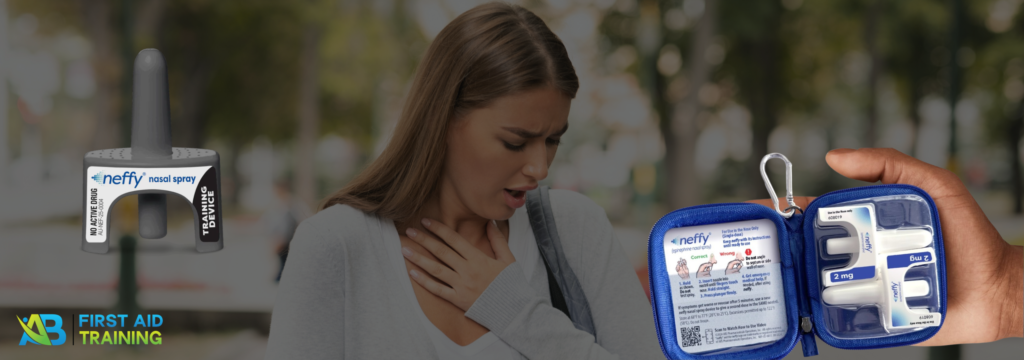
For many Australians at risk of anaphylaxis, carrying adrenaline has traditionally meant carrying an injector device. That changed when neffy, a needle-free adrenaline nasal spray, was registered for use in Australia.
The next major change arrived in July 2026, when the Australian Government added neffy to the Pharmaceutical Benefits Scheme for eligible patients. This makes the nasal spray more affordable and gives some children and adults another way to receive life-saving adrenaline during a severe allergic reaction.
Neffy is not an autoinjector. It is a single-dose nasal spray containing adrenaline, also called epinephrine. It is sprayed into one nostril and does not use a needle.
This post explains what has changed, who neffy may be suitable for, how it is used, and what schools, workplaces, childcare services, families and first aiders need to do next.
What is neffy?
Neffy is a prescription adrenaline nasal spray used for the emergency treatment of severe allergic reactions, including anaphylaxis. Adrenaline remains the first-line emergency treatment for anaphylaxis. Neffy changes the way the medicine is delivered, but it does not change the importance of giving adrenaline quickly when signs of anaphylaxis appear.
Each neffy device contains one fixed dose of adrenaline, is used in one nostril, is ready to use without assembly, does not contain a needle, must not be tested or pre-sprayed, and cannot be reused after the dose has been given. The device delivers its full dose when the plunger is pressed firmly. There is no need for the person to sniff or breathe in while it is being administered.
What has changed in Australia?
Australia has seen several important developments over a relatively short period.
December 2025: TGA registration
The Therapeutic Goods Administration registered both the 1 mg and 2 mg neffy products on 8 December 2025: neffy 1 mg (ARTG number 469945) and neffy 2 mg (ARTG number 470025). This meant the devices had been approved for supply in Australia under their registered indications.
Early 2026: Australian availability and new resources
During early 2026, Australian organisations began publishing updated information about neffy, including device instructions, dose information and training resources. ASCIA also released a neffy-specific 2026 Action Plan for Anaphylaxis, alongside its general and device-specific plans for other adrenaline devices.
July 2026: PBS listing
The Australian Government announced neffy as one of the new PBS listings for July 2026 — a new form of adrenaline for the emergency treatment of acute severe allergic reactions in eligible children and adults at significant risk of anaphylaxis. Without the subsidy, patients could have paid more than $95 per pack. PBS listing is important because cost can affect whether people fill prescriptions, replace expired devices and carry the recommended number of doses.
Who can use neffy?
Australian dosing is based mainly on weight. The 1 mg device is approved for children aged four years or older who weigh at least 15 kg but less than 30 kg. The 2 mg device is approved for children and adults who weigh 30 kg or more. Neffy is not approved for children under four years of age or those who weigh less than 15 kg. A doctor or nurse practitioner should determine the appropriate adrenaline device and dose for each person.
Why might a nasal spray make a difference?
Some people delay giving adrenaline because they are frightened of needles, unsure how to hold an injector, or worried about using it incorrectly. A needle-free option may reduce one barrier for some patients, parents, carers and first aiders. However, the best device is the one prescribed for the individual, carried consistently, understood by the user and given without delay when anaphylaxis occurs. People should not switch from an existing adrenaline injector to neffy without discussing it with their treating health professional.
How do you use neffy?
The basic administration steps are straightforward, but people should practise with a trainer device before an emergency occurs.
Step 1: Remove the device from its packaging. Do not press the plunger yet. Do not test or pre-spray neffy — each device contains only one dose.
Step 2: Hold the device correctly. Place your thumb on the bottom of the plunger, with one finger on each side of the nozzle.
Step 3: Insert it into one nostril until the fingers touch the nose, or as far as practical for a smaller child’s nose. Keep the nozzle straight and point it towards the forehead.
Step 4: Press the plunger firmly until the device sprays and the plunger moves upwards. Remove immediately. The person does not need to sniff or breathe in deeply.
A simple reminder from Allergy & Anaphylaxis Australia: place it in the nose, press, and up it goes.
What happens after the first dose?
Using neffy does not replace emergency medical care. After giving the first dose: call Triple Zero (000), tell the operator that adrenaline has been given, follow the person’s ASCIA Action Plan, monitor breathing and responsiveness, keep a second dose ready, and stay with the person until emergency help arrives.
If symptoms do not begin to improve after five minutes, if they become worse, or if they return, a second dose should be given using a new neffy device in the same nostril where possible. Patients are advised to carry two neffy devices at all times. More than two sequential adrenaline doses should be administered under direct medical supervision.
Can neffy be used with a blocked or runny nose?
The approved Australian product information states that neffy can be used when a person has a cold or congested nose. Clinical studies found that nasal congestion caused by upper respiratory infections did not appear to have a meaningful effect on adrenaline absorption during the first 25 minutes after the dose. People with nasal polyps, previous nasal surgery, or other structural nasal conditions should discuss this with their doctor or pharmacist. In an emergency, adrenaline should not be withheld from someone who needs it.
How should neffy be stored?
Store neffy below 25°C in an accessible location. Do not deliberately freeze it. If it freezes accidentally, allow it to thaw for at least one hour before use. If anaphylaxis occurs while the device is frozen, use another available adrenaline device rather than waiting for it to thaw. Allergy & Anaphylaxis Australia advises that brief accidental exposure to temperatures up to 50°C does not necessarily make it unusable. Monitor expiry dates and include neffy in your normal medication replacement schedule.
What side effects may occur?
Adrenaline can cause temporary effects. Commonly reported effects with neffy include headache, anxiety, tremor or shakiness, a fast or noticeable heartbeat, nasal discomfort, runny or congested nose, nose pain, and throat irritation. The possibility of side effects should not delay adrenaline during a life-threatening allergic reaction. Side effects can be reported to a health professional or directly through the TGA.
What does this mean for schools and childcare services?
Schools and childcare services may now have children whose individual plan specifies EpiPen, Anapen, Jext, or neffy. Staff need to know which device is prescribed for each child and how its operation differs. Services should: obtain the current ASCIA Action Plan for each child; check that the prescribed device matches the plan; train relevant staff in the specific device; keep trainer devices separate from real medication; ensure two doses are accessible where prescribed; review excursion and off-site procedures; and check state-specific anaphylaxis requirements. ASCIA advises that for children under 12, a caregiver should administer neffy or confirm the child is properly instructed and capable.
What does this mean for workplaces and community organisations?
Workplaces, sporting clubs, disability providers and community groups should not assume every person at risk of anaphylaxis will carry the same device. A workplace review should check whether staff recognise neffy, know it is a nasal spray and not an injector, whether device-specific instructions are displayed, whether medication storage remains within temperature limits, and whether first aid training includes practical exposure to trainer devices. Familiarity before an incident is essential.
Five important things to remember
- Neffy is not an autoinjector. It is a needle-free, single-dose adrenaline nasal spray.
- Adrenaline is still the first-line treatment. The method of delivery has changed, but the urgency has not.
- One device equals one dose. Do not test, prime or pre-spray it.
- Carry two. A second dose may be required after five minutes if symptoms do not improve, worsen or return.
- Call 000 after giving it. Adrenaline is emergency treatment, but it does not replace ambulance assessment and ongoing medical care.
Practical checklist for organisations
- Do we know which people have been prescribed neffy?
- Do we have their current ASCIA Action Plan?
- Is the correct 1 mg or 2 mg device available?
- Are two doses available where recommended?
- Have staff practised with a trainer device?
- Do staff know not to test or pre-spray the real device?
- Is the medicine stored below 25°C and easy to access?
- Are expiry dates being monitored?
- Are excursion, vehicle and off-site procedures updated?
- Do staff know to call 000 after administration?
- Can staff recognise anaphylaxis quickly?
- Are first aid and anaphylaxis qualifications current?
How AB First Aid can help
The arrival of neffy means anaphylaxis training must now cover more than one style of adrenaline device. AB First Aid helps schools, childcare services, workplaces and community organisations build practical confidence in recognising anaphylaxis and using the device prescribed for the person. Training should give people the chance to handle trainer devices, practise the steps and understand what happens after adrenaline is given.
References
- Therapeutic Goods Administration: neffy 1 mg registration (ARTG 469945)
- Therapeutic Goods Administration: neffy 2 mg registration (ARTG 470025)
- Australian Government Department of Health, Disability and Ageing: July 2026 PBS listings
- Australasian Society of Clinical Immunology and Allergy (ASCIA): 2026 Action Plans and device resources
- Allergy & Anaphylaxis Australia: neffy information and instructions
- Australian Commission on Safety and Quality in Health Care: neffy Consumer Medicine Information
Ready to make sure your team knows exactly what to do in an anaphylaxis emergency? AB First Aid offers practical, up-to-date anaphylaxis and first aid training for schools, childcare services, workplaces and community organisations across Melbourne and Victoria.
Book a course or view the public course schedule at AB First Aid in Tullamarine.

Book A Course
Recent Blogs
- All Posts
- Compliance
- First Aid
Learn how NDIS support workers should respond to seizures and epileptic episodes — duty of care, safe positioning, documentation, and...
Victorian schools must comply with Ministerial Order 1160 on anaphylaxis management. Learn what DET requires for staff training, Action Plans,...

Australia now has a second PBS-listed adrenaline auto-injector. Here’s what childcare educators, school staff and parents need to know about...
AB First Aid Training & Compliance
Have You Read These Articals Yet?
- All Posts
- Compliance
- First Aid
Learn how NDIS support workers should respond to seizures and epileptic episodes — duty of care, safe positioning, documentation, and...
Victorian schools must comply with Ministerial Order 1160 on anaphylaxis management. Learn what DET requires for staff training, Action Plans,...
Australia now has a second PBS-listed adrenaline auto-injector. Here’s what childcare educators, school staff and parents need to know about...