
It’s a Tuesday morning at a busy long day care centre in Melbourne’s northern suburbs. Twenty-two children are settled into morning snack time. A room leader notices that Liam, aged four, is scratching at his face and his eyes are swollen. Within sixty seconds, he’s struggling to breathe.
This is anaphylaxis. And what happens in the next five minutes will determine everything.
What Is Anaphylaxis — And Why Is Childcare High-Risk?
Anaphylaxis is a severe, life-threatening allergic reaction that can affect the whole body. It can be triggered by foods such as peanuts, eggs, cow’s milk, wheat, tree nuts, fish, or sesame — as well as insect stings and medications — and it can escalate from mild symptoms to cardiac arrest within minutes.
Childcare environments carry a particularly high risk. Children aged one to five are in the prime window for discovering previously unknown food allergies, and cross-contamination of food is notoriously hard to prevent in group settings. According to ASCIA (the Australasian Society of Clinical Immunology and Allergy), food allergies affect approximately one in ten Australian infants — making the chances of encountering a reaction in an early childhood setting very real.
Under ACECQA guidelines and the Education and Care Services National Regulations, childcare services must maintain up-to-date medical management plans for every enrolled child with a known allergy or medical condition. But as any experienced educator knows, anaphylaxis can occur in a child with no prior diagnosis.
Back in the Room: The First Signs
Back to Liam. The room leader who noticed him — let’s call her Priya — has completed her first aid training and recognises the warning signs immediately:
- Red, swollen face and eyes
- Hives appearing on his arms
- A hoarse, strained sound when he breathes
- Increasing distress and agitation
These are not just signs of a minor allergic reaction. The respiratory symptoms alone indicate anaphylaxis. Priya doesn’t wait to see if it gets worse.
Reaching for the EpiPen: Using the ASCIA Action Plan
Every child with a known allergy at the centre has an ASCIA Action Plan for Anaphylaxis stored in their file and a copy displayed in the medication area. Liam’s plan was completed by his GP after a mild reaction to cashews six months ago — but this is the first time it’s been needed.
Priya directs her co-educator to call 000 immediately. She retrieves Liam’s EpiPen Jr from the medication storage, and with another staff member supporting Liam’s position — sitting him upright, never lying him flat if he’s having trouble breathing — she administers the adrenaline autoinjector to his outer mid-thigh.
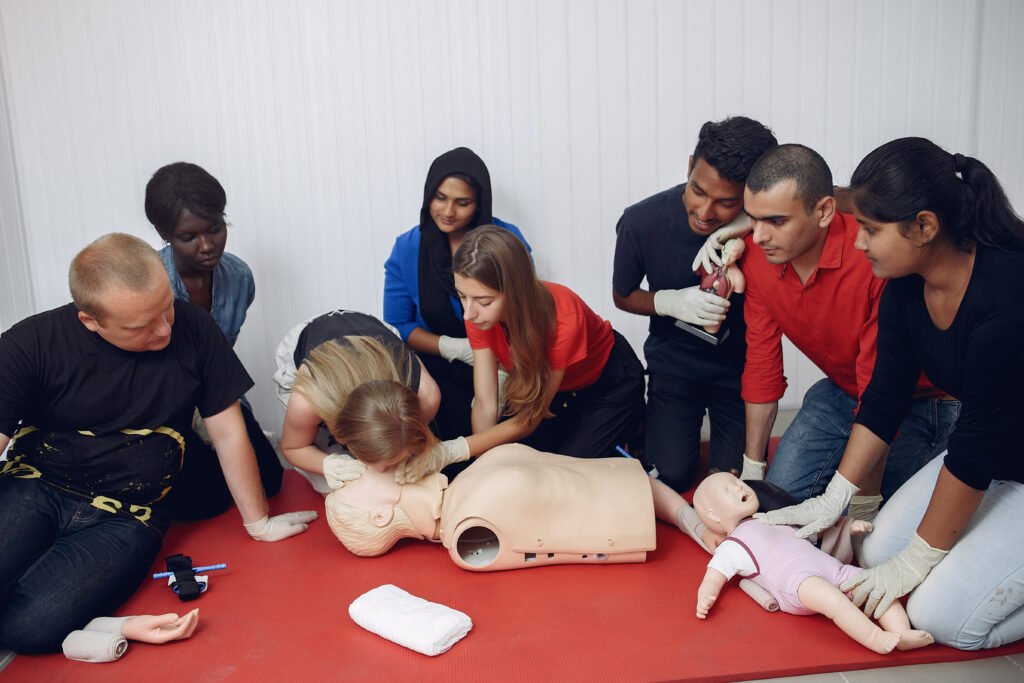
This is exactly what her training prepared her to do. Not in theory — in practice, using a trainer device, under pressure, with a clock running.
The 000 operator stays on the line. Liam is monitored closely. Within two minutes of the EpiPen, his breathing starts to ease.
What Happens After the Injection
Anaphylaxis can be biphasic — meaning a second wave of symptoms can occur hours later, even after the person has seemed to recover. This is why emergency services must always be called, even when an EpiPen appears to have worked.
When paramedics arrive, they take over care and transport Liam to hospital for observation. His parents, contacted immediately after the 000 call, are waiting there.
Back at the centre, Priya completes a full incident report. The centre director reviews the risk management plan, the food preparation procedures, and Liam’s updated medical file. A near-miss debrief takes place with all staff before the end of the day.
This is not an overreaction. It is best practice.
What This Scenario Teaches Us
Every part of this response — from recognition to administration to aftercare — was shaped by training. Priya knew what to look for. She knew how to use the ASCIA Action Plan. She had physically practised using an autoinjector. She stayed calm enough to act.
Without that training, the response could have looked very different: a delay in calling 000, uncertainty about when to use the EpiPen, or Liam being laid flat — which can worsen shock in anaphylaxis.
The Australian Resuscitation Council (ARC) and ASCIA both emphasise that early recognition and prompt adrenaline administration are the critical factors in anaphylaxis outcomes. Every minute matters.
Regulatory Requirements for Childcare
Under the Education and Care Services National Regulations (Regulations 90–96), childcare services must have a policy covering the management of medical conditions including anaphylaxis. They must also ensure that:
- A current medical management plan is on file for any child with a diagnosed allergy
- Staff are trained to administer autoinjectors and recognise anaphylaxis signs
- Medications, including EpiPens, are stored accessibly but safely
- An ASCIA Action Plan is clearly displayed and followed
WorkSafe Victoria and the Department of Education Victoria also require that first aid training is current and appropriate to the risks in the environment. ACECQA makes it clear that anaphylaxis training is not optional — it’s a core requirement for any approved childcare service.
Is Your Team Ready?
The children in your care deserve staff who can act — not just staff who know the theory. First aid training for childcare workers isn’t a box-ticking exercise. It’s the reason a child like Liam goes home safely.
AB First Aid offers nationally recognised first aid training suited to early childhood education and care settings, including hands-on anaphylaxis response practice. Our courses run regularly from our Tullamarine training centre, and we also offer group bookings for services who want to train their whole team together.
Book your first aid training today, or view the full course schedule to find a session that works for your team.
References
- ASCIA (Australasian Society of Clinical Immunology and Allergy). (2024). Anaphylaxis Management. Retrieved from https://www.allergy.org.au
- Australian Resuscitation Council. (2021). ARC Guideline 9.2.7: Anaphylaxis. Retrieved from https://resus.org.au
- ACECQA. (2024). Medical Conditions Policy Guidance. Retrieved from https://www.acecqa.gov.au
- Education and Care Services National Regulations 2011 (Cth), Regulations 90–96.
- WorkSafe Victoria. (2024). First Aid in the Workplace. Retrieved from https://www.worksafe.vic.gov.au
- Department of Education Victoria. (2024). Anaphylaxis Guidelines for Schools and Early Childhood Services. Retrieved from https://www.education.vic.gov.au