Asthma is one of the most common chronic conditions in Australian children, affecting around 1 in 9 kids under the age of 14. In a childcare setting, that means at least one child in your care is likely to have asthma — and at some point, you may need to respond to an episode. The good news is that most asthma episodes are manageable when educators know what to do. The challenge is recognising the signs early, having the right equipment accessible, and acting before the situation escalates.
Why Childcare Educators Need to Be Prepared
Under the National Quality Framework (NQF), childcare services have a clear legal obligation to manage the health and safety of every child in their care. This includes maintaining current medical management plans for children with known asthma, ensuring adequate staff hold appropriate first aid qualifications, and having documented procedures for responding to medical emergencies.
Asthma Australia notes that young children often cannot accurately describe how they are feeling — they may not say “my chest feels tight” or “I can’t breathe properly.” This places a significant responsibility on educators to recognise symptoms independently and act quickly, without waiting for a child to ask for help.
Recognising an Asthma Episode
Asthma symptoms can appear suddenly, particularly during or after active play, in cool or dry weather, or when a child is exposed to a trigger such as dust, pollen, animal dander, mould, or cigarette smoke. Common signs of an asthma episode in a young child include:
- A persistent cough, especially after running or physical activity
- Wheezing — a whistling or tight sound when the child breathes out
- Visible effort to breathe, with the neck, chest, or stomach muscles visibly working
- The child becoming unusually quiet, stopping play suddenly, or looking anxious
- Pale or slightly bluish lips in more severe cases
It is worth noting that not every asthma episode includes wheezing. Some children, particularly those under five, present mainly with a persistent dry cough. If a child is coughing repeatedly and seems uncomfortable or distressed, treat it seriously and follow your asthma response procedure.
The Four-Step Asthma First Aid Action
The Australasian Society of Clinical Immunology and Allergy (ASCIA) and Asthma Australia both recommend the following four-step approach for responding to an asthma episode. This is sometimes called the “4 x 4 x 4” rule.
Step 1 — Sit the child upright. Keep them calm and comfortable in an upright sitting position. Do not lay them down. Reassure them that help is here — anxiety makes breathing harder.
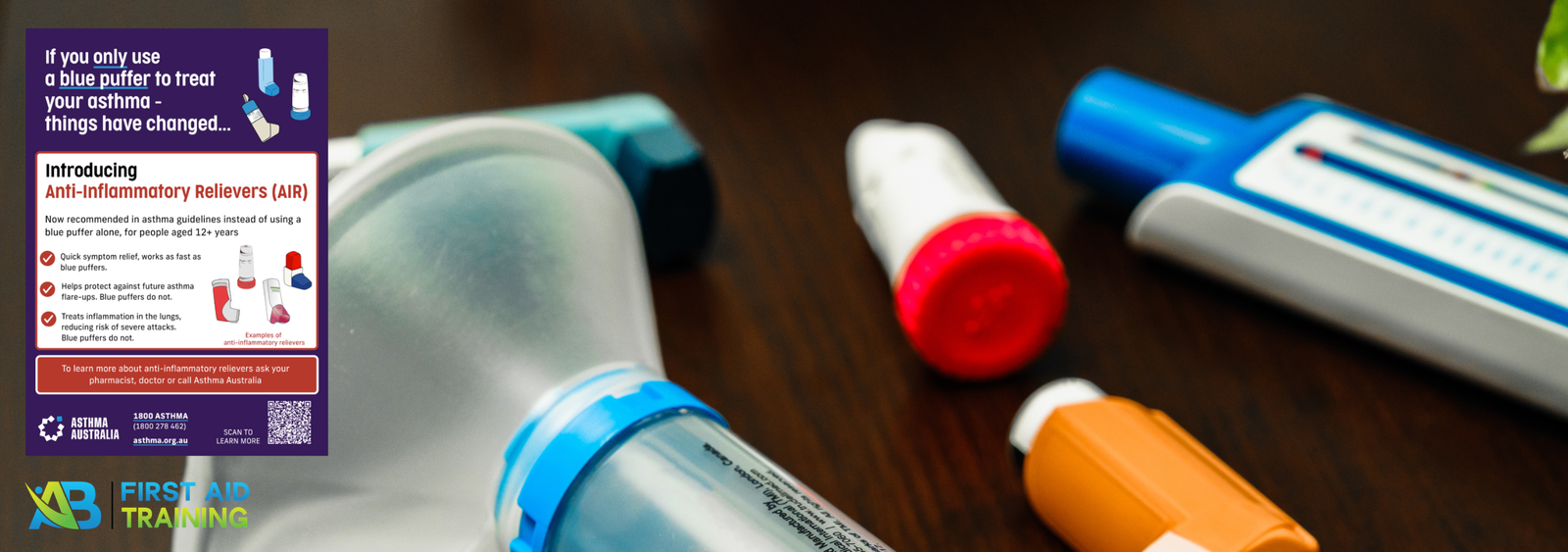
Step 2 — Give 4 puffs of a reliever inhaler through a spacer. A blue reliever inhaler (salbutamol, such as Ventolin) should always be used with a spacer device. Give 4 separate puffs, with the child taking 4 breaths through the spacer after each puff. Children under six should use a spacer fitted with a face mask.
Step 3 — Wait 4 minutes. If there is no improvement after 4 minutes, give 4 more puffs using the same technique.
Step 4 — Call 000 if there is no improvement. If the child is not responding after the second round of 4 puffs, or if their condition is deteriorating at any point, call triple zero immediately. Continue giving 4 puffs every 4 minutes until the ambulance arrives. Do not leave the child unattended.
Why Spacers Are Essential
Many services keep a reliever inhaler on hand, but a spacer is just as important — especially for young children who cannot coordinate the timing of breathing in and pressing the inhaler. Without a spacer, a large proportion of the medication is deposited in the mouth and throat rather than reaching the lungs where it is needed.
Each child with asthma should ideally have their own labelled spacer kept at the service. ASCIA recommends washing spacers monthly using warm water and dishwashing liquid (without scrubbing the inside), allowing them to air dry, and replacing them every 12 months or sooner if they are cracked or damaged.
Check that inhalers are within their expiry date as part of your regular medication audit. An expired inhaler may not deliver a full dose when it is most needed.
Asthma Action Plans and Your Regulatory Obligations
If a child enrolled at your service has a confirmed asthma diagnosis, you are required under the Education and Care Services National Regulations to have a current medical management plan signed by their doctor. This plan should clearly outline the child’s known triggers, their regular medication, and what steps to take in an emergency.
Asthma action plans should be stored in a location that is immediately accessible to all educators — not locked away in a filing cabinet. They should be reviewed whenever a child’s medication or management changes, and updated copies obtained at the start of each year or whenever a child re-enrols.
ACECQA’s guidance makes clear that services must have documented, practiced procedures for medical emergencies, and that all relevant staff must be trained and confident to carry them out. Having a plan on file is not enough if the educators in the room on any given day do not know where it is or what it says.
First Aid Qualification Requirements for Childcare
Under the National Quality Framework, each room in an early childhood education and care setting must have at least one educator present with a current first aid qualification, anaphylaxis management training, and emergency asthma management training at all times during operating hours.
Emergency asthma management is a standalone competency — it is not automatically included in a standard first aid certificate. If your team’s qualifications are due for renewal, it is worth confirming that emergency asthma management is covered rather than assuming it will be.
What to Do After an Asthma Episode
Once the immediate episode has been managed, there are several important follow-up steps:
- Notify the child’s parents or guardians immediately, regardless of how mild the episode appeared
- Document the incident in your incident, injury, trauma and illness record as required under the National Regulations
- Arrange for the child to be collected and assessed by a doctor, even if they seem fully recovered
- Review the child’s asthma action plan with the family to check whether it needs updating
Children who required more than one round of 4 puffs, or who needed an ambulance, should always be reviewed by a GP or paediatrician before returning to care.
Helping Your Team Stay Ready
An asthma episode in a busy childcare room is stressful. The educators who respond most calmly and effectively are those who have practised the steps — not just read about them once. Running through asthma response scenarios as a team, checking that spacers and inhalers are in date, and confirming that every educator knows where action plans are kept all make a measurable difference when it counts.
It is also worth building asthma awareness into your orientation process for new staff and for families. When everyone understands the triggers, the signs, and the response, episodes are less likely to escalate.
Book Asthma First Aid Training with AB First Aid
AB First Aid offers first aid, CPR, anaphylaxis management, and emergency asthma management courses from our training centre in Tullamarine. Our courses are practical, engaging, and specifically designed for people working in childcare and early education — so you leave genuinely prepared, not just certificated.
View our public course schedule or contact us to arrange group training for your whole team. See available courses at AB First Aid — Tullamarine.
References