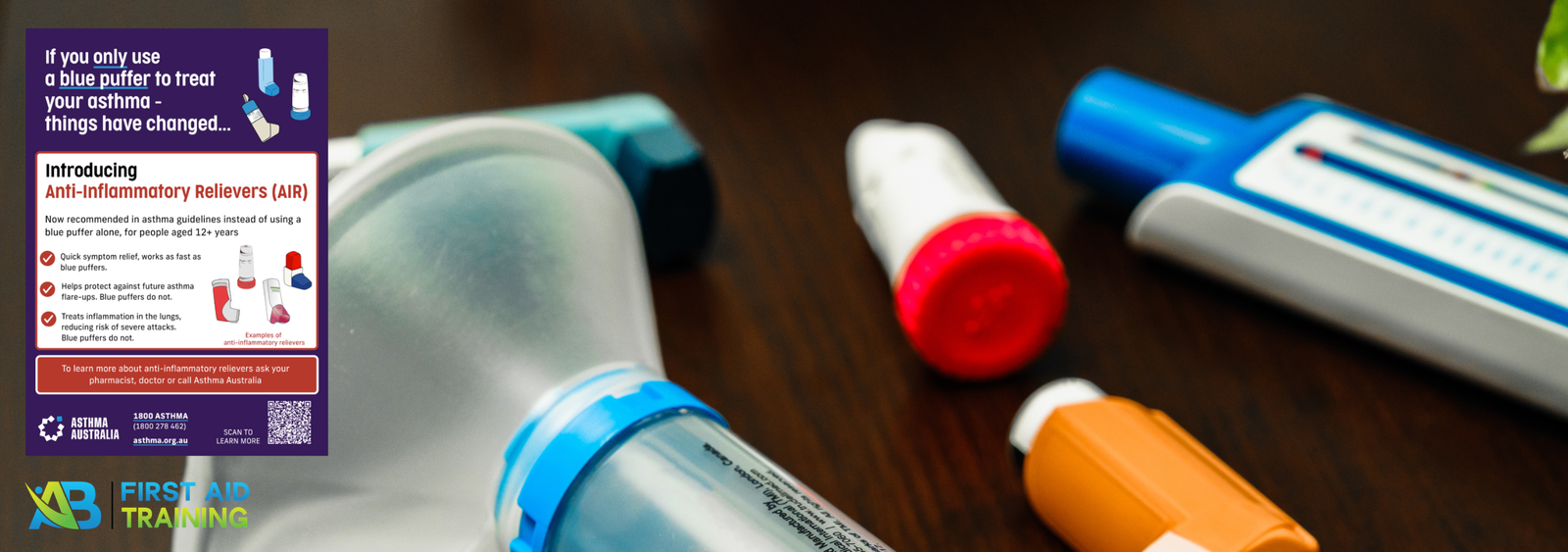
Australia’s asthma guidelines have changed. Learn what AIR therapy means and why blue puffers alone are no longer recommended for many people.

First Aid Requirements for Victorian Schools: What the Law Actually Requires
Australia’s asthma guidelines have changed. Learn what AIR therapy means and why blue puffers alone are no longer recommended for many people.
The Most Common First Aid Hazards on Electrical Worksites
Australia’s asthma guidelines have changed. Learn what AIR therapy means and why blue puffers alone are no longer recommended for many people.
First Aid Compliance in Childcare: What ACECQA and Victorian Regulations Actually Require
Australia’s asthma guidelines have changed. Learn what AIR therapy means and why blue puffers alone are no longer recommended for many people.
Common First Aid Myths Electrical Workers Should Stop Believing
Common First Aid Myths NDIS Support Workers Should Stop Believing
Australia’s asthma guidelines have changed. Learn what AIR therapy means and why blue puffers alone are no longer recommended for many people.
What to Do When a Student Has a Seizure: A Practical Guide for School Staff
Australia’s asthma guidelines have changed. Learn what AIR therapy means and why blue puffers alone are no longer recommended for many people.
Why First Aid Training Is Essential for Childcare Workers
Childcare workers do more than educate and care for young children — they are often the first responders when something goes wrong. Whether it’s a choking incident, an allergic reaction, or a fall in the playground, the ability to respond quickly and correctly can make a significant difference to a child’s outcome. If you work in a childcare setting in Victoria, first aid training isn’t just best practice — in most cases, it’s a legal requirement. Here’s what you need to know. What the Regulations Say The National Quality Framework (NQF), administered by ACECQA (Australian Children’s Education and Care Quality Authority), sets out clear expectations for first aid qualifications in early childhood education and care (ECEC) settings. Under the Education and Care Services National Regulations, services must ensure that at least one educator with a current approved first aid qualification is present at all times when children are in care. This includes HLTAID012 Provide First Aid in an Education and Care Setting (or the approved equivalent), an anaphylaxis management qualification, and an asthma management qualification. These are not optional extras. Meeting these requirements is part of achieving and maintaining a quality rating under the NQF, and failing to comply can put your service — and more importantly, the children in your care — at serious risk. Current requirements are available on the ACECQA website at acecqa.gov.au. What Can Go Wrong in a Childcare Setting? Children between the ages of 0 and 5 are particularly vulnerable to a range of medical emergencies. These are some of the most common incidents that childcare workers encounter. Choking is one of the most serious risks for young children. Small objects, food items, and even toys can become lodged in a child’s airway, and without immediate action, the results can be fatal. Knowing how to perform back blows and chest thrusts correctly — and staying calm enough to do so — requires practice, not just reading a manual. Allergic reactions, including anaphylaxis, are increasingly common in young children. Anaphylaxis is a severe, life-threatening reaction that requires immediate use of an adrenaline auto-injector (such as an EpiPen) and a call to 000. Without trained staff on site, a delay of even a few minutes can have devastating consequences. Asthma attacks are another frequent occurrence in childcare settings. Victoria has one of the highest rates of childhood asthma in Australia, and knowing how to manage an acute attack — including how to use a spacer and metered dose inhaler — is essential for any childcare worker. Febrile seizures, falls, fractures, and head injuries are also common in ECEC settings. In each case, a calm, trained response makes a measurable difference to the outcome for the child. First Aid Training Is Not a One-Off Many childcare workers complete their initial first aid qualification and assume that’s enough. But first aid knowledge fades over time, and techniques are updated as medical evidence evolves. ACECQA recommends that first aid qualifications are renewed every three years, with CPR updated annually. This isn’t just a bureaucratic requirement — it’s about ensuring that the people responsible for children’s safety are genuinely ready to respond when it matters. Regular refresher training also builds confidence. There’s a real difference between someone who attended a course three years ago and someone who practised CPR compressions last month. Muscle memory matters when you’re dealing with a real emergency and your hands are shaking. Creating a First Aid-Ready Environment Training your team is the foundation, but it’s not the whole picture. A first aid-ready childcare centre also: WorkSafe Victoria recommends that all workplaces — including childcare centres — conduct regular reviews of their first aid procedures and equipment. The childcare environment is particularly dynamic, with new enrolments bringing new medical needs throughout the year. The Difference Trained Staff Make When a child collapses or stops breathing, the minutes before an ambulance arrives are critical. Early CPR significantly improves survival outcomes — and while cardiac arrest is rare in young children, it does happen, particularly following drowning, choking, or severe allergic reaction. In those moments, the response of a trained childcare worker can be the difference between a child who recovers fully and one who doesn’t. That’s not an exaggeration — it’s the reality of working in a high-care environment. Beyond emergencies, trained staff also make better day-to-day decisions. They’re more likely to recognise the early signs of illness or distress, respond appropriately to minor injuries, and document incidents correctly — all of which contributes to a safer, higher-quality service overall. Book Your Team’s First Aid Training Today AB First Aid delivers practical, engaging first aid training for childcare workers and ECEC services across Melbourne and Victoria. Our courses are nationally recognised, meet ACECQA requirements, and are delivered by experienced trainers who understand the real-world demands of working with young children. We offer flexible scheduling to suit childcare rosters, including on-site group training for your whole team. Whether you need to get new staff qualified or bring your existing team’s skills up to date, we’re here to help. View our upcoming public course schedule or get in touch to discuss group bookings at AB First Aid in Tullamarine. Book your team’s training today and make sure you’re ready when it matters most. Visit abfirstaid.com.au or call us to find out more. References
The Most Common First Aid Emergencies NDIS Support Workers Face — And Why Training Matters
Disability support workers do some of the most varied, physically demanding, and emotionally complex work in the care sector. No two shifts look the same. You might spend the morning supporting someone with complex physical needs, the afternoon assisting with community access, and the evening responding to a mental health episode — all in the same day. That variety is part of what makes the work meaningful. It’s also what makes solid first aid training so important. NDIS support workers are regularly present when health emergencies occur. In many cases, you are the first — and only — person on scene before paramedics arrive. Understanding the specific risks in your role can mean the difference between a well-managed emergency and a preventable harm. Why the NDIS Sector Has Unique First Aid Risks The people NDIS workers support often live with conditions that increase the likelihood of a medical emergency. Many participants have complex health profiles, which may include epilepsy, severe allergies, diabetes, respiratory conditions, or cardiovascular disease. Some have limited ability to communicate symptoms clearly. Others may have behaviours of concern that can escalate unexpectedly. According to the NDIS Quality and Safeguards Commission, registered NDIS providers have a duty to ensure workers are trained and competent to respond to health-related incidents. Despite this, many workers report feeling underprepared when emergencies actually happen. That’s not a reflection of their commitment — it’s a reflection of how specific the risks are, and how rarely generic first aid training addresses the realities of disability support work. Seizures and Epilepsy Management Epilepsy is one of the most prevalent conditions among NDIS participants. A significant number of people with intellectual disability, acquired brain injury, or cerebral palsy experience seizures as part of their health profile. For support workers, knowing how to respond correctly is critical. Common mistakes include restraining the person during a seizure, placing something in their mouth, or leaving them unattended too quickly after the seizure ends. All of these can cause serious harm. The Australian Resuscitation Council (ARC) provides clear guidelines on seizure management. Key steps include protecting the person from injury by clearing the environment, placing them in the recovery position once convulsions stop, and monitoring their breathing. Call 000 if the seizure lasts more than five minutes, if a second seizure follows without recovery, or if the person does not regain consciousness. Many NDIS participants will have a seizure management plan as part of their support documentation. Workers should be familiar with that plan and know how to act within it. Anaphylaxis and Severe Allergic Reactions Severe allergic reactions are another high-risk emergency in the NDIS sector. Participants may have allergies to foods, medications, insect stings, or latex — and may not always be able to clearly communicate when they are reacting. According to ASCIA (the Australasian Society of Clinical Immunology and Allergy), anaphylaxis can progress within minutes and requires immediate administration of adrenaline via an auto-injector (EpiPen). Workers must know how to recognise the signs — swelling, hives, difficulty breathing, collapse — and how to use the auto-injector correctly if the participant has one prescribed. Waiting to see if symptoms improve before acting is one of the most dangerous responses to a suspected anaphylaxis. Train. Practise. Act. Choking and Airway Obstruction Choking is a significant and underappreciated risk in disability support settings. Participants with dysphagia (difficulty swallowing), cerebral palsy, Down syndrome, or acquired brain injuries may have impaired swallowing reflexes, making mealtimes a genuine risk window. Support workers who assist with meals or feeding need to understand modified texture food guidelines, recognise early signs of choking, and know how to respond effectively — including back blows, abdominal thrusts, and when to call 000. For participants who are non-ambulatory or use a wheelchair, standard choking response techniques may need to be adapted. This is exactly the kind of scenario that should be practised in training, not improvised in an emergency. Falls and Musculoskeletal Injuries Falls are among the most frequently reported incidents in NDIS settings, both for participants and workers. Safe Work Australia identifies the disability support sector as one of the highest-risk industries for musculoskeletal injuries, often related to manual handling tasks like transfers and personal care. When a participant falls, workers need to assess the situation calmly before acting. Moving someone incorrectly after a fall — particularly if a head, neck, or spinal injury is suspected — can cause serious secondary harm. First aid training covers the DRSABCD protocol and how to conduct a basic injury assessment while waiting for further assistance. Workers also need to understand their own physical limits and safe handling procedures to prevent injuring themselves in the process. Mental Health Crises and Behaviours of Concern Many NDIS participants experience mental health conditions or behaviours of concern that can escalate into crisis situations. While this isn’t strictly “first aid” in the traditional sense, de-escalation and crisis response are part of the practical safety skill set every support worker needs. Workers should understand the difference between a mental health episode and a medical emergency (some can overlap — for example, extreme anxiety can resemble a cardiac event). Knowing when to call 000, when to contact a clinical team, and how to keep both the participant and yourself safe is a core competency in this sector. Heat-Related Illness Community access activities — outings, transport, outdoor events — expose participants to heat stress risks, particularly in the Australian summer. Participants with reduced capacity to communicate may not be able to tell you they’re feeling unwell, which means workers need to be proactive about recognising the warning signs. Heat exhaustion and heat stroke can progress quickly, particularly in people with limited mobility or certain medications that affect thermoregulation. Health Victoria recommends ensuring adequate hydration, limiting sun exposure during peak heat, and knowing the symptoms of heat-related illness — dizziness, confusion, hot dry skin, rapid pulse — and how to respond. What Does This Mean for Your First Aid Training? Standard first aid training covers the fundamentals. But if
Managing a Seizure at School: What Every Staff Member Needs to Know
It happens without warning. A student is sitting in class, at the oval, or in the library — and then they’re on the ground, shaking. For many school staff, it’s one of the scariest things they’ll ever witness. But with the right knowledge, you can stay calm, act correctly, and make a real difference to that student’s safety. This guide walks you through exactly what to do when a student has a seizure, what not to do, and how Australian schools are expected to prepare for these situations. Understanding Seizures in a School Setting Seizures occur when there’s a sudden burst of abnormal electrical activity in the brain. They can affect anyone, but they’re most commonly associated with epilepsy — a neurological condition that affects around 1 in 100 Australians, according to Epilepsy Australia. Many children with epilepsy attend mainstream schools and lead full, active lives. Not all seizures look the same. A tonic-clonic (grand mal) seizure — the kind most people picture — involves muscle stiffening and rhythmic jerking. But seizures can also appear as brief staring episodes, sudden muscle jerks, or confused and automatic behaviour. School staff need to recognise all types, not just the dramatic ones. Step-by-Step: How to Manage a Tonic-Clonic Seizure The Australian Resuscitation Council (ARC) and Epilepsy Action Australia both provide clear guidance on seizure first aid. Here’s what to do: 1. Stay calm and stay with the student. Your presence matters. Keep other students back and give the person space — don’t crowd them. 2. Note the time. Check when the seizure started. This matters for what comes next. 3. Protect from injury. Clear away hard or sharp objects nearby. Do not restrain the person. Do not hold their limbs down — this can cause injury to both of you and does nothing to stop a seizure. 4. Cushion the head. Place something soft — a folded jacket, a bag — under their head if possible. Turn them gently onto their side once the jerking stops, to keep the airway clear. This is the recovery position. 5. Do not put anything in their mouth. This is one of the most persistent first aid myths. People cannot swallow their tongue during a seizure. Putting objects in their mouth risks injury to both you and the student. 6. Call 000 if: 7. Stay with them until they’re fully recovered. After a tonic-clonic seizure, the person will often be confused, tired, and disoriented. This is normal. Don’t leave them alone, and speak calmly and reassuringly until they’ve fully come around. Managing Absence Seizures and Other Types Absence seizures — where a student briefly stares into space and is unresponsive for a few seconds — can be easily mistaken for daydreaming or inattention. The student may not even know it happened. For staff, the key is to record occurrences and notify parents and the school’s first aid officer, especially if they’re happening frequently. No immediate physical intervention is needed, but documentation is important. Focal seizures (previously called partial seizures) may cause confused behaviour, automatisms (repetitive movements like lip-smacking or hand-rubbing), or brief loss of awareness. The student may not respond normally to you. Stay with them, speak calmly, and guide them away from danger if needed — but don’t restrain them. What Schools Are Required to Have in Place Under the Victorian Department of Education and Training (DET Victoria) guidelines, schools are required to have a first aid policy and to support students with health conditions including epilepsy. This includes developing individual healthcare plans for students who have diagnosed conditions that may result in a medical emergency. The DET Victoria guidelines on supporting students with medical conditions require schools to ensure relevant staff are trained and that individual management plans are in place. For students with known epilepsy, this may include specific instructions from a neurologist or paediatrician about rescue medication and when to call an ambulance. WorkSafe Victoria also requires workplaces — including schools — to maintain an adequate number of trained first aiders and a stocked first aid kit appropriate to the hazards present. Seizure management is a core competency in any recognised first aid qualification. Having a Plan Before It Happens The best time to prepare for a seizure is before one happens. Schools should: Epilepsy Action Australia recommends that schools develop an Epilepsy Management Plan in consultation with the student’s family and treating doctor. These plans are school-specific and detail triggers, warning signs, the type of seizures the student has, and any rescue medication that may be prescribed. After the Seizure: Supporting the Student Once the student has recovered, they’ll likely need to rest. Some students feel embarrassed or distressed about having a seizure in front of their peers. How staff handle the aftermath matters as much as the first aid itself. Speak privately, use a calm tone, and avoid drawing unnecessary attention. Notify parents or carers, document the incident in the school’s first aid record, and follow up with the school’s student wellbeing team if needed. Classmates may also have questions or concerns. A calm, matter-of-fact response from the teacher — without sensationalising the event — helps normalise the situation and reduces stigma for the student involved. Make Sure Your Staff Are Ready Knowing what to do in those first few minutes can be the difference between a well-managed emergency and one that causes additional harm. First aid training gives school staff the confidence to act correctly, stay calm, and support a student until professional help arrives. AB First Aid runs practical, nationally recognised first aid courses from Tullamarine, designed for school staff and education workers across Melbourne. Courses cover seizure management, CPR, anaphylaxis response, and more — delivered in a clear, practical format that actually sticks. If your school’s first aid certificates are coming up for renewal — or you want to get the whole staff trained — view the course schedule and enrol at AB First Aid. We’ll make sure your team is ready. References