
If you work in early childhood education, you already know that first aid isn’t a box-ticking exercise. When something happens with a child — a severe allergic reaction, a seizure, an injury in the playground — the response of the people in that room matters enormously. Getting it right requires current training, the right qualifications, and a clear understanding of your legal obligations under the National Quality Standard.
This post sets out exactly what first aid qualifications childcare centres need in Victoria, what the law requires under the Education and Care Services National Regulations, and how to make sure your centre stays compliant and your team stays confident.
What the National Regulations Require
The Education and Care Services National Regulations 2011, administered in Victoria by the Department of Education, set minimum first aid requirements for all approved childcare providers operating under the National Quality Framework (NQF). These apply to long day care, family day care, outside school hours care (OSHC), and kindergarten programs.
Under Regulation 136, every approved provider must ensure that at least one educator with current first aid, emergency asthma management, and anaphylaxis management qualifications is present at all times when children are being educated and cared for.
The required qualifications are:
First Aid: Provide First Aid (HLTAID011) or the equivalent — and it must be current. ACECQA recommends renewal every three years, with CPR updated annually via HLTAID009 (Provide Cardiopulmonary Resuscitation).
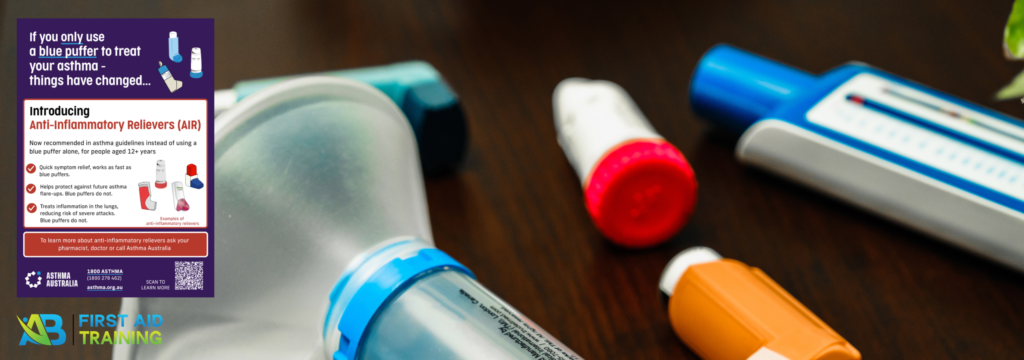
Emergency Asthma Management: An approved asthma first aid course. Asthma Australia’s one-hour course (online or face-to-face) is widely accepted and renewal is required every three years.
Anaphylaxis Management: An approved anaphylaxis management course. The Australasian Society of Clinical Immunology and Allergy (ASCIA) accredits courses for this purpose. ASCIA’s free online training for education staff (anaphylaxis e-training) is accepted in most jurisdictions, though face-to-face training with a registered training organisation is also available. Renewal is required every two years.
At least one person holding all three of these qualifications must be on-site at all times — not in the building next door, not at lunch, and not on leave without a qualified replacement on-site.
How Many Trained Staff Do You Need?
The regulation sets a minimum of one qualified person at all times, but this is a floor, not a recommendation. The Australian Children’s Education and Care Quality Authority (ACECQA) guidance on Quality Area 2 (Children’s Health and Safety) encourages services to consider their specific context — the number of children enrolled, the age groups present, the layout of the premises, and the range of health needs in their cohort.
In practice, most quality childcare services aim to have multiple trained educators on staff and rostered strategically so that there is always someone qualified available across all rooms and outdoor spaces. A single trained person covering a full centre with 60 or 70 children is a risk management problem waiting to happen.
If your centre has children enrolled with known anaphylaxis risk, an individual anaphylaxis management plan (IAMP) must be in place for each child, and all staff who work with that child must be familiar with the plan and comfortable using an auto-injector (such as an EpiPen) in an emergency. This goes beyond holding a certificate — it means active, ongoing preparation.
Anaphylaxis and Allergy: The High-Stakes Scenario
Anaphylaxis is the first aid emergency most closely associated with early childhood settings, and for good reason. Children with previously undiagnosed allergies can have a first reaction in care. Known allergies can be triggered by foods brought in by other families, by cross-contamination in meal preparation, or by incidental contact during play.
ASCIA estimates that food allergy affects around one in ten infants and around 4-8% of children in Australia. The prevalence is highest in the early years, which means childcare centres see more of these emergencies than almost any other workplace setting.
When a child shows signs of anaphylaxis — difficulty breathing, swelling of the face or lips, hives combined with vomiting or collapse, sudden paleness and limpness — the first aider must act immediately: administer the auto-injector (adrenaline) from the child’s emergency kit, call 000, and begin CPR if the child is unresponsive and not breathing. These are not steps to deliberate over. They are a sequence that trained staff need to have rehearsed to the point of automatic response.
Regular anaphylaxis drills — not just certificate renewal, but practice using a trainer EpiPen — are strongly encouraged by ASCIA and reflected in ACECQA’s quality assessment criteria.
Paediatric First Aid: What’s Different About Children
Standard first aid training covers adult-focused scenarios in most of its content, but the HLTAID011 qualification includes paediatric components: infant and child CPR ratios differ from adult protocols, children’s airways are smaller and more easily obstructed, and certain medications and treatments used in adult first aid are not appropriate for young children.
Beyond these technical differences, childcare educators benefit from scenario-based practice that reflects their actual environment: responding to a head injury in a toddler room, managing a febrile seizure, recognising the difference between a child who is choking and one who is making noise, and calming an injured child while simultaneously directing other children to a safe area and communicating with a parent.
These are the situations educators actually face. Good first aid training for childcare staff is designed with this context in mind.
Keeping Your Centre Compliant
Compliance with Regulation 136 is assessed during quality assessment and rating visits by the regulatory authority — in Victoria, that is the Department of Education. Failure to have the required qualifications current and on-site at all times can result in an immediate compliance action and, in serious cases, referral for investigation.
To stay on top of compliance, childcare directors and operations managers should maintain a register of staff first aid qualifications including the type of certificate, date of issue, renewal due date, and the registered training organisation that issued it. First aid qualifications (HLTAID011) expire after three years; CPR (HLTAID009) expires after one year; anaphylaxis certificates are typically two years.
When staff leave, go on extended leave, or qualifications expire, the centre’s compliance position can change overnight. Building in reminders at the 60-day and 30-day mark before expiry gives enough lead time to book refresher training without gaps in coverage.
Group Training Options for Childcare Teams
Coordinating individual staff members to attend public training sessions can be difficult around rostering, leave, and operational requirements. Many childcare services find it easier to arrange group training for their whole team at once — typically at a time when the centre is closed, such as a pupil-free day or a staff development day.
Group training lets the whole team train together, ask questions specific to their setting, and practice scenarios that reflect their actual environment. It also means everyone’s renewal date is the same, which makes compliance tracking much simpler.
Book First Aid Training for Your Childcare Team
AB First Aid runs nationally recognised first aid and CPR training at our centre in Tullamarine, Melbourne. We offer group bookings for childcare services, with scheduling that works around your roster — including sessions outside standard business hours.
Our trainers have experience delivering first aid training in early childhood contexts and can tailor the practical components to reflect the scenarios your team is most likely to face. We cover HLTAID011 (Provide First Aid), HLTAID009 (CPR), and can coordinate with anaphylaxis and asthma training providers as part of a broader staff development program.
View our public course schedule or enquire about a group booking at abfirstaid.com.au. We’re based in Tullamarine and work with childcare services across Melbourne and regional Victoria.
References
- Australian Children’s Education and Care Quality Authority (ACECQA). National Quality Standard. acecqa.gov.au
- Education and Care Services National Regulations 2011 (Vic), Regulation 136. legislation.vic.gov.au
- Australasian Society of Clinical Immunology and Allergy (ASCIA). Anaphylaxis e-training for childcare and schools. allergy.org.au
- Asthma Australia. Asthma first aid training. asthma.org.au
- Department of Education Victoria. Education and care services. education.vic.gov.au
- Safe Work Australia. First aid in the workplace. safeworkaustralia.gov.au

Book A Course
Recent Blogs
- All Posts
- Compliance
- First Aid

The correct first aid for burns and scalds in early childhood services, from 20 minutes of cool running water to...
A practical guide for Victorian electrical contractors on first aider numbers, qualifications, first aid kits and AEDs, and how to...
Victorian childcare services must have staff trained in anaphylaxis management, and this guide covers what that looks like in practice...
AB First Aid Training & Compliance
Have You Read These Articals Yet?
- All Posts
- Compliance
- First Aid
The correct first aid for burns and scalds in early childhood services, from 20 minutes of cool running water to...
A practical guide for Victorian electrical contractors on first aider numbers, qualifications, first aid kits and AEDs, and how to...
Victorian childcare services must have staff trained in anaphylaxis management, and this guide covers what that looks like in practice...