
Working in early childhood education and care means spending your days with curious, energetic children who are still learning their own physical limits. That combination of energy and inexperience means childcare settings have a distinct set of first aid risks — and being prepared for them isn’t optional.
Understanding the most common hazards in your service isn’t just good practice. Under the Education and Care Services National Law and National Regulations, approved services must maintain current first aid qualifications and have a first aid policy in place. ACECQA requires that at least one staff member with current first aid, anaphylaxis management, and asthma first aid training is present at all times during operating hours.
Here’s a straightforward look at what you’re most likely to face — and what to do about it.
Choking
Choking is one of the most serious and time-critical emergencies in childcare. Children under five have small airways and are still developing their chewing and swallowing skills. They also put things in their mouths constantly — food, small toys, coins, bottle caps.
Food is the most common cause of choking in young children, with grapes, hard lollies, raw carrots, and whole nuts among the highest-risk items. The Royal Children’s Hospital Melbourne includes choking as one of the most frequent paediatric emergencies requiring immediate first aid intervention.
If a child can cough forcefully, encourage them to keep coughing. If they cannot cough, cry, or breathe, you need to act immediately:
- For infants under 12 months: five back blows between the shoulder blades, then five chest thrusts
- For children over 12 months: five back blows, then five abdominal thrusts (Heimlich manoeuvre)
- Call 000 if the object is not cleared or the child loses consciousness
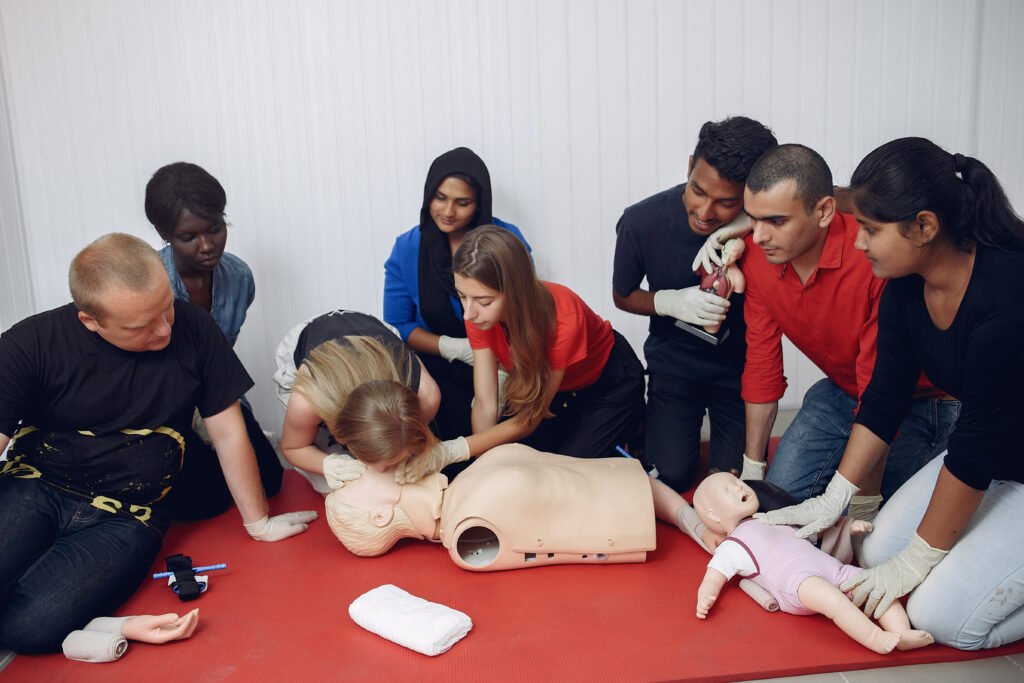
This is a first aid skill that needs hands-on practice to perform confidently under pressure. Reading about it and doing it are two very different things.
Anaphylaxis
Anaphylaxis is a severe, life-threatening allergic reaction that can develop within minutes of exposure to a trigger. In childcare settings, the most common triggers include peanuts, tree nuts, eggs, cow’s milk, sesame, wheat, and insect stings.
The Australasian Society of Clinical Immunology and Allergy (ASCIA) estimates that around one in 20 Australian children has a food allergy, making childcare services a high-risk environment. Children with known allergies should have an ASCIA Action Plan and an adrenaline auto-injector (such as an EpiPen) on site at all times.
Signs of anaphylaxis include swelling of the face, lips, or throat; difficulty breathing or swallowing; a sudden drop in blood pressure causing paleness and limpness; and vomiting or diarrhoea alongside other symptoms.
The first response is to administer the adrenaline auto-injector immediately, then call 000. Antihistamines alone are not sufficient treatment for anaphylaxis — they will not stop a severe reaction.
Under the Education and Care Services National Regulations, services that enrol a child with a diagnosed anaphylaxis risk must have a risk minimisation strategy in place and a staff member with current anaphylaxis management training on duty at all times.
Febrile Seizures
Febrile seizures are convulsions triggered by a sudden spike in body temperature. They are most common in children aged six months to five years. For most children, they stop on their own within one to five minutes and cause no lasting harm — but witnessing one for the first time is frightening, and knowing what to do matters.
During a febrile seizure:
- Clear the space around the child of anything hard or sharp
- Place them on their side in the recovery position to keep their airway clear
- Do not restrain the child or put anything in their mouth
- Time the seizure — if it lasts longer than five minutes, call 000
After the seizure, the child will be drowsy and confused. Keep them comfortable, notify parents or guardians immediately, and seek medical advice. The Raising Children Network recommends that any child who has a first-time febrile seizure be assessed by a doctor, even if they appear to recover quickly.
Falls and Head Injuries
Falls are the leading cause of injury in Australian children, according to Kidsafe Australia. In childcare settings, falls happen on climbing equipment, from furniture, and on wet or uneven ground. Most falls result in minor bumps and grazes — but a fall involving the head warrants careful monitoring.
Signs of a serious head injury include loss of consciousness (even briefly), persistent vomiting after the fall, unequal pupils, confusion or unusual drowsiness, and seizures following the injury.
If any of these signs are present, call 000 immediately. For minor bumps, apply a cold compress, record the incident, and advise parents to watch for changes in behaviour, sleep, or balance at home over the next 24 hours.
WorkSafe Victoria and Safe Work Australia both require that workplace injuries — including those involving children in your care — are recorded and reported appropriately. Keeping detailed incident records protects both children and staff.
Burns and Scalds
Burns are a significant risk in childcare, particularly near kitchen areas or any space where hot drinks or food are present. Young children have thinner skin than adults, so even brief contact with hot liquid can cause a serious scald injury.
The first response to a burn or scald is to cool the area under cool (not cold or iced) running water for at least 20 minutes, starting within three hours of the injury. Do not apply butter, toothpaste, or ice — these cause further damage and increase infection risk.
For any burn larger than a 20-cent piece, or any burn on the face, hands, feet, or genitals, call 000 or transport the child to emergency immediately. Scalds from hot liquids are consistently among the most common paediatric burn injuries presenting to hospital emergency departments in Australia.
Asthma
Asthma is one of the most common chronic conditions in Australian children. Asthma Australia reports that approximately one in nine Australians has asthma, with children making up a significant proportion of that group. In a childcare environment, common triggers include dust, mould, animal dander, pollen, physical activity, and respiratory infections.
If a child in your care has asthma, they should have a current written Asthma Action Plan from their doctor and a reliever inhaler (usually a blue puffer) and spacer on site at all times.
Signs of an asthma flare-up include persistent coughing, wheezing, tightness in the chest, and difficulty breathing. Follow the child’s Asthma Action Plan and use their spacer and puffer as directed. If there is no improvement after four puffs, or the child is deteriorating, call 000.
Being Prepared Is Part of the Job
First aid emergencies in childcare are not rare edge cases — they are a regular part of working with young children. The good news is that most of them are manageable when staff are properly trained and know exactly what to do before an emergency happens.
Current first aid training gives you the skills to stay calm, respond correctly, and keep children safe until further help arrives. It also keeps your service compliant with the requirements set out under the National Quality Framework and the Education and Care Services National Regulations.
If your first aid, anaphylaxis, or asthma certification is due for renewal — or if you want to build genuine confidence in your skills — book your first aid training with AB First Aid in Tullamarine. View the course schedule and enrol online today.
References
- Australian Children’s Education and Care Quality Authority (ACECQA). Guide to the National Quality Framework. https://www.acecqa.gov.au
- Australasian Society of Clinical Immunology and Allergy (ASCIA). Anaphylaxis resources and Action Plans. https://www.allergy.org.au
- Asthma Australia. Asthma facts and statistics. https://www.asthma.org.au
- Kidsafe Australia. Child injury prevention — falls. https://www.kidsafe.com.au
- Royal Children’s Hospital Melbourne. Clinical Practice Guidelines — Choking. https://www.rch.org.au/clinicalguide
- Raising Children Network. Febrile convulsions (febrile seizures). https://raisingchildren.net.au
- Safe Work Australia. Work health and safety in early childhood education and care. https://www.safeworkaustralia.gov.au
- WorkSafe Victoria. Incident notification and recording requirements. https://www.worksafe.vic.gov.au