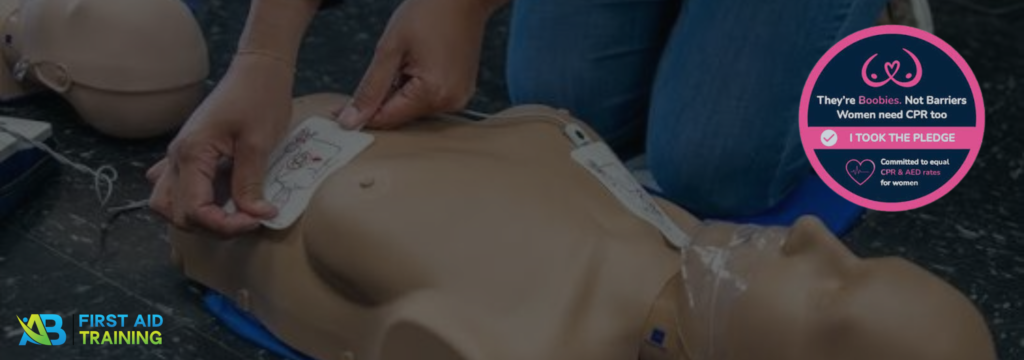
When the Boobies Not Barriers campaign took the stage at the NIFAT Conference 2026, Dr Janet Bray from Monash University stepped up to show the room what the numbers actually say.
Dr Bray chairs the Basic Life Support Task Force with the Australian Resuscitation Council, leads research through Aus-ROC (the Australasian Resuscitation Outcomes Consortium), and co-authors BLS guidelines. The data she presented came from the Aus-ROC OHCA Epistry 2023 — a national registry covering a capture population of 32 million people across Australia and New Zealand.
What she shared was sobering.
The CPR gap
Looking at adult cardiac arrest cases of presumed medical cause in Australia in 2023:
Women received bystander CPR in 35.9% of cases. Men received it in 39.8%. While some of that overall gap is explained by demographic differences (women tend to arrest at older ages, more often at home, more often unwitnessed), one finding is harder to explain away.
When you look at age and sex together, younger women (18 to around 50) are actually more likely to receive bystander CPR than men of the same age. But older women, who make up the largest share of cardiac arrests, receive significantly less. And in public locations specifically, women are less likely to receive bystander CPR than men, regardless of age.
The AED gap is even bigger
The data on AED use was stark. Women are significantly less likely to receive AED shocks across every group measured:
- All attended cases: Women 1.0%, Men 2.8%
- Public locations (Utstein group): Women 11.8%, Men 20.6%
- Private locations: Women 0.3%, Men 0.8%
That near-doubling in public AED use in favour of men is one of the most actionable findings. These are cases where an AED was available and someone chose not to use it, or used it at a lower rate. That is a training gap.
The recognition problem
NSW Ambulance data from 2017 to 2019 (4,491 bystander-witnessed arrests) showed that cardiac arrest in women is recognised during the triple-zero call at a rate of 84.6%, compared to 91.6% in men. That 7-point gap explains approximately 44% of the difference in bystander CPR rates. When cardiac arrest isn’t recognised in the call, the call taker cannot give CPR instructions. The chain breaks before it starts.
The #1 reason people hesitate
A US national survey of 548 adults found the #1 barrier to giving CPR to a woman in public was fear of legal or sexual assault charges — cited by 58.2% of respondents. Three major themes emerged: sexualisation of women’s bodies, a belief that women are physically fragile and prone to injury, and a widespread misconception that women do not have cardiac arrests or heart disease.
One participant said: “I can’t even imagine this happening. I don’t think this is a real fact.”
Another: “I’m too afraid to touch to be honest with you mate, I’m sorry.”
These are not rare attitudes. They are mainstream. And they are influencing survival outcomes.
Frequently asked questions
Does the data actually prove that hesitation about touching breasts is the cause of the CPR gap?
The research doesn’t prove a single direct cause, but the evidence points strongly in that direction. A US survey found 58.2% of CPR-trained people cited fear of legal/sexual assault charges as their number one barrier to giving CPR to a woman. A UK survey found 33% of people were afraid to give CPR because of concern about touching breasts. A Monash University simulation study found that when given a female mannequin, men were significantly more hesitant to remove clothing — only 2 out of the male group removed the bra, compared to nearly half of women. The pattern is consistent across multiple countries and study designs.
Are women at greater risk of injury from CPR than men?
No. This is one of the most persistent and damaging misconceptions. Survey participants described women as “smaller and more fragile” and worried compressions “might cause further injury if the woman is particularly small.” This is not supported by evidence. Broken ribs are a possible consequence of effective CPR in both men and women, and a broken rib is survivable. Untreated cardiac arrest is not.
The data shows younger women get more bystander CPR than younger men. Does that mean the problem is only for older women?
Not exactly. The age interaction is interesting — younger women do receive more bystander CPR than younger men in the overall dataset. But in public locations specifically, the gap for women persists across age groups. And since older women make up the majority of cardiac arrests, the net effect on the whole population is negative. The public-location finding is the most actionable one for trainers to address.
Is the AED gap also about hesitation?
Almost certainly in part, yes. AED use requires placing pads directly on the skin, which means directly engaging with a woman’s chest and, potentially, a bra. The Aus-ROC data showed AED use is lower for women across every setting — public, private, bystander-witnessed, EMS-resuscitated. The Monash University study showed that men in a simulated setting were significantly more hesitant to remove or adjust clothing on a female patient. Teaching people what to do and normalising it in training is the most direct intervention available.
Train with people who take the evidence seriously
At AB First Aid in Tullamarine and Melton, we build training from the research up.
Tullamarine: 2/7-9 Butler Way, Tullamarine VIC 3043
Melton: 1/39 Collins Road, Melton
Phone: (03) 8364 8984
Email: info@abfirstaid.com.au
Web: abfirstaid.com.au
Data presented by Dr Janet Bray, Monash University / Aus-ROC, at the NIFAT Conference 2026, Amora Hotel, Adelaide, 26 August 2026.