Button batteries are everywhere. They power remote controls, key fobs, bathroom scales, greeting cards, and dozens of household items found in every childcare centre, family day care home, and OSHC service across Australia. They are also one of the most dangerous objects a young child can swallow — and Australian guidelines for how to respond have just been updated in a way every educator working with children needs to know.
If a child in your care swallows or is suspected to have swallowed a button battery, this is a medical emergency. Fast action — and the right action — can significantly reduce the risk of serious, permanent injury.
Why Button Batteries Are So Dangerous
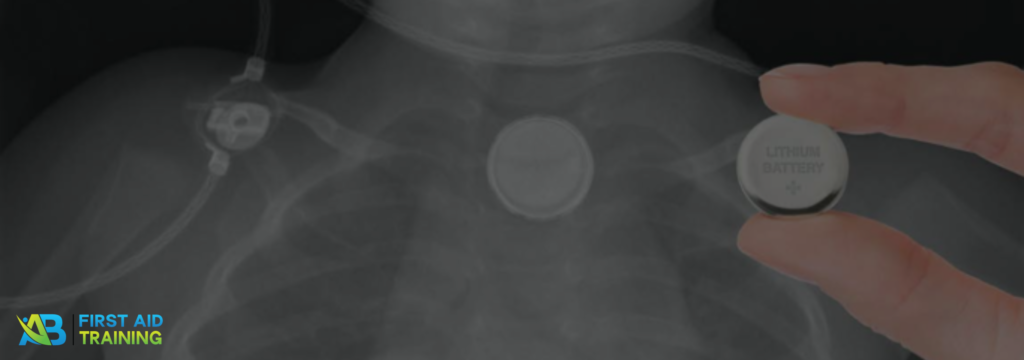
A button battery lodged in the oesophagus does not just sit there. It generates an electrical current that reacts with saliva to produce sodium hydroxide — the same caustic chemical found in industrial drain cleaners. This reaction destroys tissue rapidly.
Injury has been observed in experimental models within 15 minutes of ingestion, and damage worsens over time. Critically, a battery does not need to be new or fully charged to be dangerous. An old, seemingly dead button battery can still cause severe internal injury or death.
Young children — particularly those under five — are most at risk because they are at the right height to reach batteries left on low surfaces, and their oesophagus is narrow enough for a battery to become lodged. The Australian Competition and Consumer Commission (ACCC) has identified button batteries as one of Australia’s highest-priority product safety hazards for children.
The Updated Australian Guideline: Honey vs Jam
ANZCOR (Australian and New Zealand Committee on Resuscitation) Guideline 9.5.1 — First Aid Management of Poisoning — now includes specific, age-based advice about what to give a child when button battery ingestion is suspected.
Research suggests that honey’s viscosity may help slow tissue damage in the oesophagus by reducing pH changes and creating a protective barrier around the battery. However, the guideline now makes a critical distinction by age:
- Children 12 months and over: give 10 mL (2 teaspoons) of honey every 10 minutes until they reach a higher level of medical care. If honey is not available, use jam.
- Children under 12 months: give 10 mL (2 teaspoons) of jam every 10 minutes until they reach a higher level of medical care. Do not give honey.
The reason honey is excluded for babies under 12 months is the risk of infant botulism. Honey can contain Clostridium botulinum spores, which are harmless to older children and adults but potentially fatal in infants whose gut flora is not yet developed enough to prevent the spores from germinating. This is a well-established risk that applies any time honey is given to a baby under 12 months — not just in a button battery emergency.
The Rule Every Educator Should Know
The key update is simple to remember:
Under one? Jam, not honey.
And regardless of age, the single most important thing is this: giving honey or jam should never delay calling 000 or getting the child to emergency medical care. These measures are a first aid bridge — not a substitute for medical treatment. The battery must be removed by medical professionals as quickly as possible.
What to Do If You Suspect Button Battery Ingestion
If a child in your care has swallowed — or is suspected to have swallowed — a button battery:
- Call 000 immediately or transport the child to an emergency department without delay.
- Do not wait until you are certain. If you suspect ingestion, treat it as an emergency.
- If the child is 12 months or over: give 10 mL honey every 10 minutes while awaiting or travelling to medical care.
- If the child is under 12 months: give 10 mL jam every 10 minutes. Do not give honey.
- If the child is having difficulty breathing or there is any bleeding from the mouth: give nothing by mouth. Call 000 immediately.
- Do not try to induce vomiting.
- Notify the child’s family as soon as possible.
- Document the incident as required under NQF Regulation 87.
Symptoms may not appear immediately, and visible signs may be absent in the first hour even while internal damage is occurring. Do not wait for symptoms before acting.
Reducing Button Battery Risks in Your Service
Prevention is the first line of defence. Regular auditing of your service for button battery hazards is an important part of risk management under the National Quality Framework.
- Identify items containing button batteries — remote controls, digital thermometers, clocks, musical toys, decorative lights, and scales are common sources.
- Ensure battery compartments are secured with screws and are inaccessible to children.
- Store spare batteries — both new and used — in locked cupboards out of children’s reach and sight.
- Dispose of used batteries promptly and safely. Do not leave them on benches or in accessible bins.
- Include button battery safety in staff inductions and parent communications at enrolment.
Book First Aid Training for Your Childcare Team
AB First Aid delivers practical, up-to-date first aid training for educators and childcare professionals in Tullamarine and across Melbourne’s north. Our courses include HLTAID012 Provide First Aid in an Education and Care Setting, designed specifically for early childhood educators and covering real paediatric emergency scenarios — including choking, anaphylaxis, asthma, and poisoning emergencies.
View our public course schedule or enquire about group bookings for your service at abfirstaid.com.au. Our Tullamarine training centre is conveniently located for services across Melbourne’s northern suburbs, and we offer tailored in-house training for teams who prefer on-site delivery.
References
- Australian and New Zealand Committee on Resuscitation (ANZCOR). (2024). Guideline 9.5.1: First Aid Management of Poisoning. anzcor.org
- Australian Competition and Consumer Commission (ACCC) / Product Safety Australia. Button batteries. productsafety.gov.au
- Australian Children’s Education and Care Quality Authority (ACECQA). (2023). First Aid in Education and Care Services. acecqa.gov.au
- Therapeutic Goods Administration (TGA). Infant botulism — warning about honey for infants under 12 months. tga.gov.au
- National Institutes for First Aid Training (NIFAT). (2026). Button Battery First Aid Update: What Trainers Need to Know. nifat.com.au