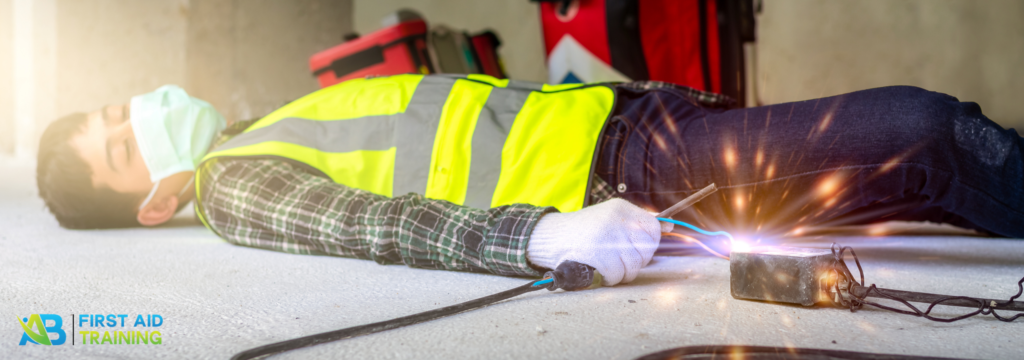
Electrocution is one of the most time-critical emergencies a workplace can face. Unlike many other injuries, cardiac arrest following an electrical shock can happen without warning — and without a fast, correct response, survival rates drop sharply with every passing minute.
For electrical workers, construction crews, and maintenance teams, understanding what to do in the seconds after a colleague is struck by current is not optional. Neither is having properly trained first aiders on site. Here is what every electrical worker and their employer needs to know.
Why Electrocution Is Different
Electrical injuries are not the same as other trauma. When current passes through the body, it can disrupt the heart’s electrical system, causing ventricular fibrillation — a chaotic, ineffective heartbeat that quickly becomes cardiac arrest. This can occur even with relatively low voltages, and it can happen with a delay of several minutes after the initial shock.
There are other serious effects too. The entry and exit wounds from electrical current may look small, but internal tissue damage can be extensive. Arc flash injuries — caused by the explosive energy released during an electrical fault — produce intense radiant heat that causes severe burns to skin, eyes, and the respiratory tract. Blast force from arc flash can also cause blunt trauma injuries.
WorkSafe Victoria notes that electrical incidents account for a significant number of serious injuries and fatalities in Victorian workplaces each year, particularly in the construction and electrical trades sectors.
Step One: Scene Safety
The most important thing to remember when someone is electrocuted is that you cannot help them if you become a casualty yourself. Before approaching, confirm the power has been isolated. Do not touch a person who may still be in contact with a live source — even indirect contact through water or metal can conduct current to you.
Call 000 immediately. In high-voltage situations, trained emergency responders and energy network personnel should be involved before any rescue attempt.
Once the scene is confirmed safe, begin your assessment.
Performing CPR After Electrocution
The fundamentals of CPR after electrocution follow the same technique as any other cardiac arrest — but speed matters even more here, because the heart may have gone into ventricular fibrillation and requires defibrillation to restore a normal rhythm.
The Australian Resuscitation Council (ARC) recommends the DRSABCD sequence:
D — Danger: Check the scene is safe (power off, hazards cleared).
R — Response: Check if the person is conscious and responsive.
S — Send for help: Call 000 or direct someone to call and retrieve a defibrillator (AED).
A — Airway: Open the airway by tilting the head and lifting the chin.
B — Breathing: Look, listen, and feel for breathing. If absent or abnormal, treat as cardiac arrest.
C — CPR: Begin chest compressions — 30 compressions to 2 rescue breaths, at a rate of 100–120 compressions per minute, pressing down at least 5cm on the centre of the chest.
D — Defibrillation: Attach and use an AED as soon as it is available. Follow the prompts.
Continue CPR until the person shows signs of life, emergency services take over, or you are physically unable to continue. Do not stop to check for a pulse during compressions unless the person wakes or moves.
Burns and Secondary Injuries
Even where cardiac arrest does not occur, electrical injuries often result in burns that require immediate and specific care.
Cool the burn under cool (not cold or icy) running water for at least 20 minutes. Do not apply ice, butter, toothpaste, or any other home remedy — these worsen tissue damage. Cover loosely with a clean, non-fluffy dressing or cling film. Remove jewellery and clothing near the burn if not stuck to the skin.
For arc flash injuries, in addition to skin burns, check for eye involvement. Intense UV radiation from arc flash can damage the cornea, and symptoms may not appear immediately. Always seek medical assessment after any arc flash incident, even if the worker feels fine.
Your Legal Obligations Under WorkSafe Victoria
Under the Occupational Health and Safety Act 2004 (Vic) and its associated regulations, employers have a legal duty to provide a safe workplace, which includes adequate first aid provision. The Occupational Health and Safety Regulations 2017 (Vic) require employers to ensure first aid equipment is provided and that there is an appropriate number of trained first aiders on site.
For electrical and construction worksites, the requirements are particularly clear. Safe Work Australia’s guidance on first aid in the workplace specifies that the number of first aiders required depends on the nature of the hazards, the number of workers, and the remoteness of the site from emergency services. High-hazard industries — which includes electrical work — require more first aiders per worker than lower-risk environments.
The Australian Resuscitation Council recommends that CPR training be renewed every 12 months to maintain competency. First aid certificates are typically valid for three years, though CPR components should be updated annually in line with ARC guidelines.
Failing to meet these obligations is not just a compliance risk. In the event of a preventable death or serious injury, employers can face significant penalties under WorkSafe Victoria enforcement action, including prosecution under the OHS Act.
Defibrillators on Site
Automated External Defibrillators (AEDs) are designed to be used by anyone, including people with no medical training. They provide voice prompts and will only deliver a shock when the heart’s rhythm indicates one is needed.
For electrical worksites — particularly those remote from ambulance services — having an AED on site can be the difference between life and death. Survival rates from cardiac arrest drop by roughly 10% for each minute without defibrillation. By the time paramedics arrive, that window may have passed.
Ensure your team knows where the AED is located, how to operate it, and that it is regularly checked and maintained in accordance with the manufacturer’s instructions.
Train Your Team Before an Emergency Happens
Reading about CPR is not the same as knowing how to do it under pressure. Hands-on training — practising compressions on a manikin, using a training defibrillator, working through real-life scenarios — builds the muscle memory and confidence that matters in a genuine emergency.
AB First Aid offers practical, nationally recognised first aid training at our training centre in Tullamarine, as well as on-site group training for electrical trades and construction teams across Melbourne. Our courses cover CPR, managing electrical injuries, burns, and workplace emergency response — all delivered by experienced trainers who understand high-risk work environments.
View our upcoming public course schedule or enquire about group training for your crew at abfirstaid.com.au. Booking is straightforward, and courses run regularly to fit around your team’s roster. Don’t wait for an incident to find out your team wasn’t ready.
References
- Australian Resuscitation Council. (2021). Guideline 8 — Cardiopulmonary Resuscitation. Retrieved from resus.org.au
- Safe Work Australia. (2023). First Aid in the Workplace: Code of Practice. Retrieved from safeworkaustralia.gov.au
- WorkSafe Victoria. (2024). Electrical Safety in the Workplace. Retrieved from worksafe.vic.gov.au
- WorkSafe Victoria. (2024). Occupational Health and Safety Regulations 2017 — First Aid Requirements. Retrieved from worksafe.vic.gov.au
- Energy Safe Victoria. (2023). Electrical Incidents in the Workplace. Retrieved from esv.vic.gov.au