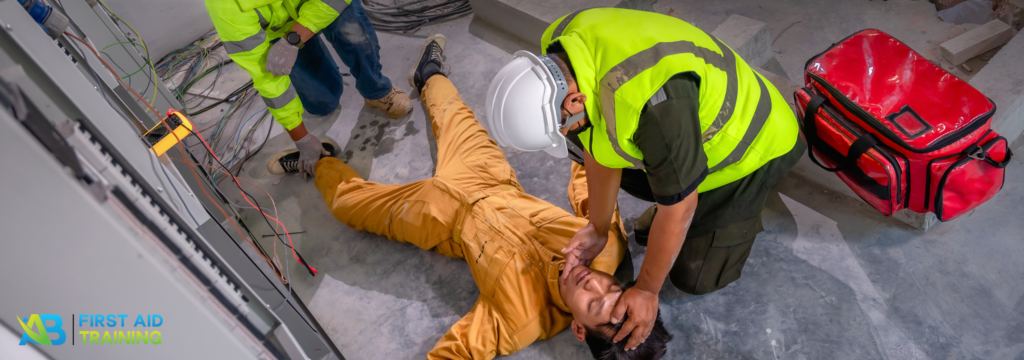
Of all the hazards electrical workers face on the job, cardiac arrest caused by electrocution is one of the most immediately life-threatening — and one of the most survivable, if the right response happens fast enough. Yet many workers on Victorian electrical and construction sites have either never had first aid training, or haven’t refreshed it in years.
This post covers what happens to the body during an electrical injury, why cardiac arrest is the primary concern, and what every electrical worker and site supervisor needs to know about responding effectively before the ambulance arrives.
Why Electrocution Causes Cardiac Arrest
Electricity passing through the body doesn’t just cause burns. The current disrupts the heart’s electrical system, which can trigger ventricular fibrillation — a chaotic, ineffective heart rhythm that prevents the heart from pumping blood. This can happen even with relatively low voltages. WorkSafe Victoria’s guidance on electrical safety notes that even household current (230 volts) can be lethal under the right conditions, particularly if the current passes across the chest.
The severity of the injury depends on the voltage, the type of current (AC or DC), the path the current takes through the body, and how long the contact lasts. High-voltage incidents — those above 1,000 volts AC — carry an even higher risk of immediate cardiac arrest, internal burns, and tissue damage that isn’t visible from the outside.
In many cases, a person may appear to be conscious or responsive immediately after an electrical shock, then collapse into cardiac arrest minutes later. This is why ongoing monitoring is critical, even when someone seems to have “walked away” from an incident.
Scene Safety: The Step That Cannot Be Skipped
The most common mistake in responding to an electrocution is failing to confirm the power source is de-energised before approaching the casualty. Touching someone who is still in contact with a live current will put the rescuer at the same risk. Multiple fatalities have resulted from well-intentioned bystanders doing exactly this.
Before approaching, confirm that:
- The power has been switched off at the source (not just the switch — isolate the circuit)
- You are not standing in water or on a conductive surface
- You can see and confirm that the casualty is no longer in contact with the live conductor
If you cannot safely isolate the power source, keep others back and call 000 immediately. Do not attempt to move the casualty with non-insulated materials unless you are trained to do so.
WorkSafe Victoria’s electrical safety obligations under the Electricity Safety Act 1998 and the Work Health and Safety Act 2011 require employers to have emergency procedures in place for electrical incidents, including trained first aid personnel on site.
The Chain of Survival for Electrical Injuries
Once the scene is safe and emergency services have been called, the priority shifts to keeping the casualty alive until paramedics arrive. The Australian Resuscitation Council (ARC) outlines a chain of survival that applies directly to electrocution-related cardiac arrest:
1. Recognise cardiac arrest early. If the casualty is unresponsive and not breathing normally, assume cardiac arrest and begin CPR immediately. Do not waste time checking for a pulse if you are not trained to do so accurately.
2. Call 000. Do this simultaneously if there are others present, or before starting CPR if you are alone and the casualty cannot be revived without AED access.
3. Begin CPR. ARC’s current guidelines recommend 30 chest compressions to 2 rescue breaths for trained responders, or continuous compressions only for untrained bystanders. Push hard and fast — at least 5–6 cm deep for an adult, at a rate of 100–120 compressions per minute. Do not stop until the AED is ready to analyse, the casualty shows signs of life, or emergency services take over.
4. Use the AED as soon as it’s available. Automated External Defibrillators can detect ventricular fibrillation and deliver a shock to restore normal rhythm. The ARC’s research consistently shows that early defibrillation is the single most effective intervention in cardiac arrest caused by ventricular fibrillation. Many Victorian construction sites are now required to have AEDs on site — if yours doesn’t, talk to your supervisor about WorkSafe Victoria’s requirements for your workplace classification.
5. Hand over to paramedics. When emergency services arrive, brief them on how long CPR has been in progress, the number of shocks delivered by the AED, and the circumstances of the injury — including the estimated voltage and duration of contact.
After the Shock: Hidden Injuries to Watch For
Even if a casualty regains consciousness or appears uninjured, electrical injuries frequently cause internal damage that is not immediately visible. These include:
- Internal burns along the path the current travelled through the body
- Muscle breakdown (rhabdomyolysis), which can cause kidney failure hours after the event
- Spinal injuries, particularly if the person fell or was thrown by the shock
- Cardiac arrhythmias that may not appear immediately but can become dangerous over the following 24–48 hours
For this reason, anyone who has received an electrical shock should be assessed by medical professionals, even if they are conscious and appear fine. Do not allow them to drive themselves to hospital. Keep them still, warm, and monitored until ambulance officers assess and transport them.
First Aid Training Requirements for Victorian Electrical Workers
Under WorkSafe Victoria’s requirements, workplaces are required to have an adequate number of trained first aiders based on the size, location, and hazard level of the site. For high-risk workplaces — which includes most electrical and construction environments — this typically means having personnel trained to at least HLTAID011 (Provide First Aid), with current CPR certification renewed annually as recommended by the ARC.
The Model Code of Practice: First Aid in the Workplace, adopted by Safe Work Australia and implemented in Victoria, sets out clear guidance on first aid kit requirements, first aider ratios, and emergency response procedures. Supervisors and site managers should be familiar with these obligations and ensure that first aid training is not treated as a one-off box-ticking exercise.
Refresher training matters because CPR guidelines are updated regularly. The ARC released updated guidelines in 2016 and has continued to refine best-practice recommendations. Workers trained five or more years ago may be using outdated techniques — and in a cardiac arrest situation, technique matters.
Book First Aid Training for Your Electrical Team in Tullamarine
AB First Aid runs practical, engaging first aid courses from our training centre in Tullamarine, with courses designed for trade and construction environments. We cover CPR, AED use, electrical injury response, and workplace first aid compliance — so your team is genuinely prepared, not just ticking a box.
View our upcoming public course schedule or enquire about group training for your crew at abfirstaid.com.au. We keep sessions hands-on and relevant to the work your team actually does.
References