When an infant stops breathing in a childcare setting, the first few minutes are critical. Cardiac arrest in babies and young children is uncommon, but when it happens, it almost always results from a respiratory problem — an obstructed airway, drowning, or severe illness — rather than a heart condition. That means if an educator can recognise the signs early and start CPR, the outcome can be significantly different.
Knowing what to do is not just good practice. For childcare educators in Victoria, it is a legal obligation.
Why Infant CPR Is Different from Adult CPR
CPR for infants (under 12 months) and young children differs from adult CPR in several important ways. Compressions are gentler, the rescue breath technique changes, and the ratio of compressions to breaths remains 30:2 — consistent with Australian Resuscitation Council (ARC) guidelines.
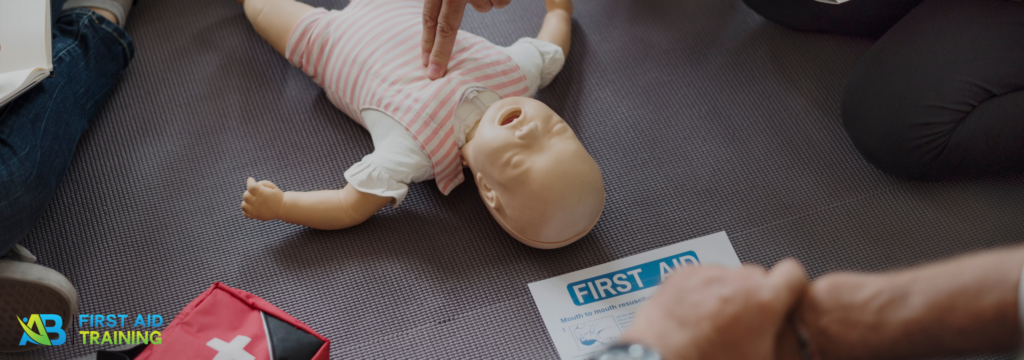
For an infant, use two fingers (or two thumbs with hands encircling the chest for a two-person technique) to compress the centre of the breastbone, just below the nipple line. Compress to one-third the depth of the chest — approximately 4 centimetres. Deliver 30 compressions at a rate of 100–120 per minute, then give two gentle rescue breaths, covering both the mouth and nose of the infant with your mouth. Each breath should cause a visible rise in the chest.
For a young child (aged 1 to puberty), the technique shifts to one or two hands on the lower half of the sternum, compressing to approximately 5 centimetres.
The ARC’s guidelines are regularly updated and available at resus.org.au. Any first aid training your staff undertake should align with the most current ARC guidance.
Recognising When CPR Is Needed
CPR is required when an infant or child is unresponsive and not breathing normally. Agonal breathing — occasional gasps or irregular, noisy breaths — is not normal breathing and should be treated as if breathing has stopped.
The DRSABCD action plan applies: check for Danger, assess Response, Send for help by calling Triple Zero (000), open the Airway by gently tilting the head back and lifting the chin, check Breathing for no more than 10 seconds, begin CPR with 30 compressions followed by 2 rescue breaths, and apply Defibrillation with an AED as soon as one is available.
Do not delay starting CPR to wait for an ambulance. Ambulance Victoria’s dispatch team can guide you through the steps by phone while help is on the way.
What ACECQA and the NQF Require
Under the Education and Care Services National Law and Regulations, every approved childcare service must ensure that first aid qualified educators are present at all times when children are in care. This is a minimum staffing requirement — not an optional add-on.
ACECQA requires that each service have at least one educator with a current approved first aid qualification, and at least one with current anaphylaxis and asthma management training. In practice, most services aim for higher ratios to ensure coverage across shifts, meal breaks, and staff absences.
The approved first aid qualification for early childhood educators in Victoria is typically the HLTAID012 — Provide First Aid in an Education and Care Setting. This unit specifically covers infant and child CPR, anaphylaxis, asthma, and other childhood emergencies. It must be renewed every three years.
In addition to meeting qualification requirements, services are strongly encouraged to conduct regular first aid drills so that the steps become automatic under pressure. Practising infant CPR on a manikin is very different from reading about it.
Using an AED on a Child
Automated External Defibrillators (AEDs) are increasingly common in public spaces and some childcare environments. When a child’s heart has entered a dangerous rhythm such as ventricular fibrillation, defibrillation can be lifesaving.
Most AEDs are designed for adult use but can be used on children over 8 with standard adult pads, provided the pads do not touch each other. For children under 8, paediatric pads should be used where available. If paediatric pads are not available, adult pads can be used in an alternative placement — one on the chest and one on the back.
If an AED is available, apply it as early as possible — but do not stop CPR until it is ready to analyse. The AED will provide voice instructions and will only deliver a shock if one is needed.
After the Emergency: Documentation and Reporting
Even if the child recovers before the ambulance arrives, every incident involving loss of consciousness or CPR must be documented and reported. Under the National Regulations, this means completing an incident, injury, trauma and illness record, notifying parents or guardians as soon as possible, and — in Victoria — notifying the regulatory authority within 24 hours of a serious incident.
After any significant first aid event, consider the impact on other children and staff who may have witnessed or been near the incident. Debriefing and access to support is important for the whole team.
Get Your Team Trained at AB First Aid
Infant CPR is a skill that can make the difference between life and death — and it is one that needs regular practice to stay sharp. Theory fades; muscle memory built through hands-on training with manikins and real-time feedback is what holds up in a genuine emergency.
AB First Aid in Tullamarine runs regular courses for childcare educators and OSHC staff, including the HLTAID012 qualification and tailored refresher sessions for teams who need to update their skills. Our trainers understand the early childhood environment and deliver training that is practical, engaging, and directly applicable to your day-to-day role.
To book a course or view our upcoming public schedule, visit abfirstaid.com.au or contact the AB First Aid team in Tullamarine. We also offer onsite training for services that want to train their entire team together at your centre.
References
Australian Resuscitation Council (ARC). (2021). Guideline 12.1 — Cardiopulmonary Resuscitation. resus.org.au
Australian Children’s Education and Care Quality Authority (ACECQA). (2024). First Aid Policy Requirements under the National Quality Framework. acecqa.gov.au
Ambulance Victoria. (2024). CPR — What to Do. ambulancevictoria.com.au
Department of Education Victoria. (2024). First Aid in Early Childhood Services. education.vic.gov.au