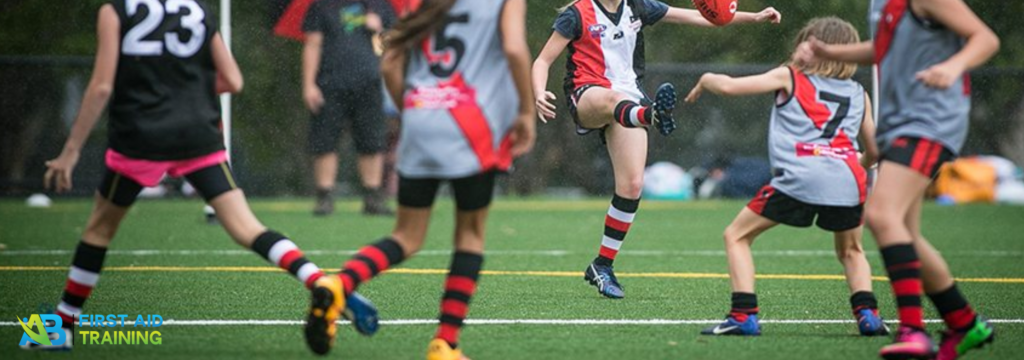
Sport is a vital part of school life. Whether it’s lunchtime footy, a cross-country race, or a regional swimming carnival, physical activity brings enormous benefits — but it also carries a real risk of injury. When something goes wrong on the oval or in the pool, school staff are often first on scene.
Understanding how to respond to common sports injuries, and when to hold a student back from activity, is part of every school’s duty of care. This post covers the practical first aid response for the most common sports injuries in Victorian schools, along with what staff should know about return-to-play decisions.
What Are Schools Responsible For?
Under the Department of Education Victoria’s (DET) duty of care obligations, schools must take reasonable steps to prevent foreseeable harm — and to respond appropriately when harm occurs. This extends to sporting activities, excursions, physical education classes, and recess and lunch breaks.
Schools are also required to have trained first aid staff available during school hours, including during sporting events and excursions. WorkSafe Victoria’s guidance on first aid in workplaces applies to schools as employers, and DET’s own policies require schools to maintain first aid kits, first aid officers, and documented response procedures.
That means staff — not just the first aid officer — benefit from understanding basic first aid for sports injuries. In a busy school environment, the teacher on the oval may be the first (and sometimes only) adult present when a student goes down.
Sprains and Strains: The RICE Method
Sprains (ligament injuries) and strains (muscle or tendon injuries) are among the most common injuries in school sport. Ankle sprains are particularly frequent, but wrist, knee, and shoulder injuries also occur regularly.
The standard first aid response follows the RICE method:
- Rest — stop activity immediately; don’t encourage the student to “walk it off”
- Ice — apply an ice pack or cold compress wrapped in a cloth for 20 minutes; never apply ice directly to skin
- Compression — apply a firm bandage to reduce swelling, working from below the injury upward
- Elevation — raise the injured limb above heart level where possible
If there is significant swelling, severe pain, inability to weight-bear, or any concern about a fracture, the student should not return to activity and parents or carers should be notified. Suspected fractures require medical assessment.
Head Injuries and Concussion
Head injuries require careful management in school settings, and concussion in particular has received increasing attention in recent years. The Australian Institute of Sport (AIS), along with DET Victoria, recommends a conservative approach to concussion management in children and adolescents.
If a student takes a knock to the head — from a fall, a collision, or a hit from a ball or another player — watch for these signs of concussion:
- Headache or pressure in the head
- Dizziness or balance problems
- Confusion, slowed thinking, or “fogginess”
- Nausea or vomiting
- Sensitivity to light or noise
- Memory gaps around the event
If any of these signs are present, the student must be removed from activity immediately. Never let a student with a suspected concussion return to play the same day. Call Triple Zero (000) if the student loses consciousness, has a seizure, is vomiting repeatedly, has severe or worsening headache, or cannot be woken.
DET Victoria’s concussion guidance uses the principle: “If in doubt, sit them out.” Parents and carers must be informed and the student should be assessed by a medical professional before returning to sport or physical activity.
Fractures and Dislocations
Suspected fractures and dislocations require the student to be kept still and comfortable while waiting for medical assistance. For all but minor injuries, call Triple Zero (000) or arrange transport to an emergency department.
First aid for suspected fractures:
- Don’t try to straighten or reset the limb
- Immobilise the area in the position found — use a sling, padding, or improvised splinting if trained to do so
- Apply ice packs (wrapped in cloth) to reduce swelling
- Monitor for signs of shock: pale, cold, clammy skin; rapid breathing; dizziness
- Reassure the student and keep them as calm and still as possible
Open fractures (where bone is visible or skin is broken) are medical emergencies. Apply a sterile dressing to the wound without pressing on the bone, and call 000 immediately.
Heat-Related Illness During School Sport
Victorian summers bring real risk of heat-related illness during school sport, particularly at carnivals and outdoor events. Heat exhaustion and heat stroke can develop quickly in students who are exercising vigorously in hot conditions.
Heat exhaustion signs include heavy sweating, weakness, cool or pale skin, nausea, and dizziness. Move the student to a cool environment, encourage sipping cool water, apply cool damp cloths, and loosen clothing. Monitor closely.
Heat stroke is a medical emergency. Signs include hot, red, dry or damp skin; rapid pulse; confusion; and loss of consciousness. Call Triple Zero (000) immediately. Cool the student rapidly by any means available — cool water, wet cloths, fans — while waiting for emergency services.
Return-to-Play: Who Decides and When?
The decision to allow a student to return to sport after an injury is not one staff should make lightly. As a general principle:
- Any student with a suspected concussion, fracture, or dislocation requires medical clearance before returning to physical activity
- Students with sprains or strains should only return when they can move and weight-bear without pain — and ideally after a period of graduated activity
- Return-to-sport decisions for concussion follow a stepwise protocol: rest until symptom-free, then a gradual return over at least 7 days
Schools should document all significant sports injuries and any return-to-play decisions. Parents and carers should be informed of any injury requiring first aid or medical attention, and their written consent sought before a student returns after a significant event.
Make Sure Your Staff Are Ready
The best time to prepare for a sports injury is before it happens. Practical first aid training gives school staff the confidence to act quickly and correctly — whether that’s bandaging an ankle on the oval or recognising the signs of concussion on the basketball court.
AB First Aid offers practical, scenario-based first aid training for school staff across Melbourne and the surrounding region, delivered from our training centre in Tullamarine. We offer flexible public course dates and group booking options to suit your school’s schedule. View our public course schedule or reach out about group training at abfirstaid.com.au.
References