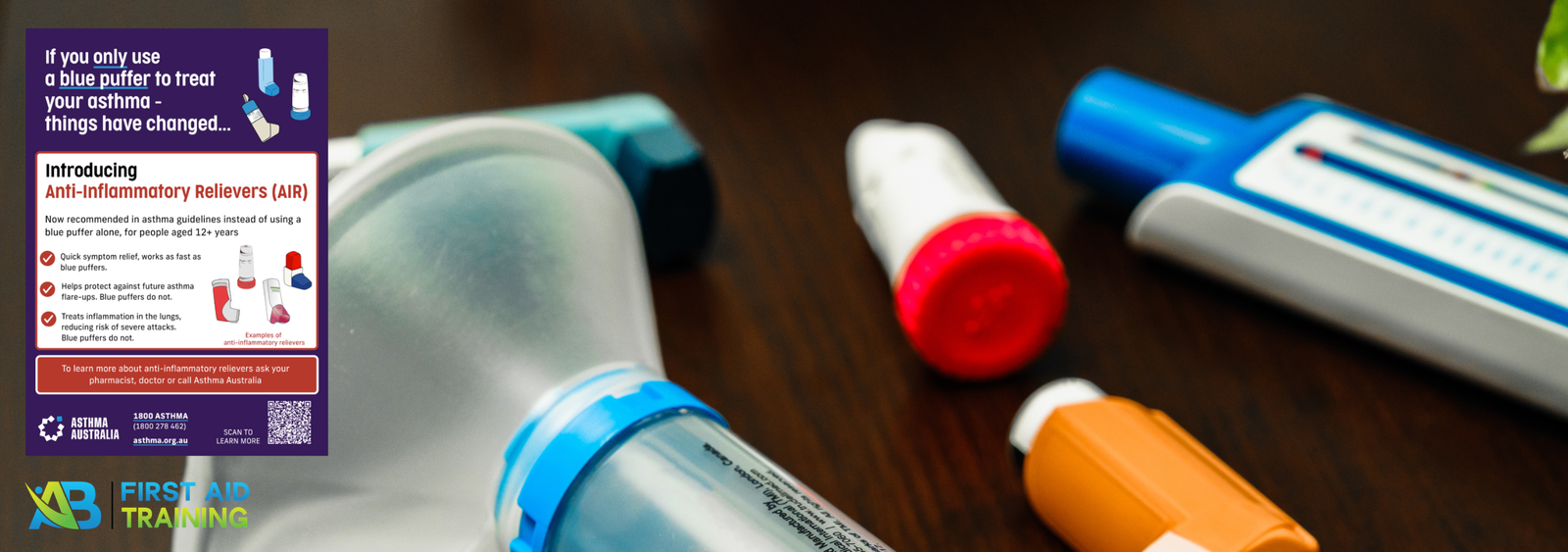
Australia’s asthma guidelines have changed. Learn what AIR therapy means and why blue puffers alone are no longer recommended for many people.
The Most Common First Aid Hazards on Electrical Worksites
Australia’s asthma guidelines have changed. Learn what AIR therapy means and why blue puffers alone are no longer recommended for many people.
First Aid Compliance in Childcare: What ACECQA and Victorian Regulations Actually Require
Australia’s asthma guidelines have changed. Learn what AIR therapy means and why blue puffers alone are no longer recommended for many people.
Common First Aid Myths Electrical Workers Should Stop Believing
Common First Aid Myths NDIS Support Workers Should Stop Believing
Australia’s asthma guidelines have changed. Learn what AIR therapy means and why blue puffers alone are no longer recommended for many people.
What to Do When a Student Has a Seizure: A Practical Guide for School Staff
Australia’s asthma guidelines have changed. Learn what AIR therapy means and why blue puffers alone are no longer recommended for many people.
Common First Aid Myths Childcare Workers Should Stop Believing
Published by AB First Aid — nationally registered first aid training provider, Tullamarine, Victoria. First aid advice spreads fast in childcare settings — through staff rooms, Facebook groups, and half-remembered training sessions. Some of it is solid. A lot of it isn’t. When it comes to real emergencies involving children, acting on outdated or incorrect information doesn’t just slow you down — it can make things worse. Here are some of the most common first aid myths circulating in early childhood settings, and what the evidence and Australian guidelines actually say. Do You Need to Tilt the Head Back When a Child Is Choking? No — tilting the head back is not recommended for a choking child, and doing so can actually push an obstruction further into the airway. The correct response for a conscious child who is choking is to give up to five back blows between the shoulder blades, followed by up to five chest thrusts. For infants under twelve months, the technique differs: use a combination of back blows and chest thrusts, and never perform abdominal thrusts (the Heimlich manoeuvre) on a baby. These guidelines come from the Australian Resuscitation Council (ARC), which sets the evidence-based standard for resuscitation training in Australia. Myth: You Should Put Butter or Oil on a Burn Putting butter, oil, toothpaste, or any other home remedy on a burn is one of the most persistent myths in first aid — and one of the most harmful. These substances trap heat in the skin, increasing tissue damage and raising the risk of infection. The correct response, as outlined by the ARC and Kidsafe Australia, is cool running water for a minimum of 20 minutes. The water should be cool, not cold or iced, to avoid causing shock or hypothermia in young children. Remove any clothing or jewellery near the burn, but do not peel away anything that is stuck to the skin. This applies to childcare settings too. If a child in your care sustains a burn, start the cooling process immediately while calling for emergency assistance if the burn is larger than a 20-cent piece, on the face or hands, or involves a very young child. Does Putting a Child in the Recovery Position Mean They Are Safe? The recovery position reduces the risk of airway blockage in an unconscious child who is breathing — but placing a child on their side is not the end of your responsibilities. You still need to monitor breathing continuously, ensure emergency services have been called, and be prepared to begin CPR if breathing stops. The recovery position is a management step, not a resolution. A child who is unconscious and breathing still requires urgent medical attention, regardless of how stable they appear in the moment. Myth: Childhood CPR Is the Same as Adult CPR The principles of CPR — compressions and breaths to restore circulation — are the same, but the technique changes significantly depending on the child’s age. For children aged one to eight years, the Australian Resuscitation Council recommends using one or two hands for chest compressions, pressing down approximately one-third of the chest depth. For infants under twelve months, use two fingers on the centre of the chest. Compression ratios and breath volumes also differ. Using adult CPR technique on a young child can cause injury, and being unfamiliar with the differences wastes critical time during an emergency. Under the Education and Care Services National Regulations, childcare services in Victoria are required to have at least one staff member with a current approved first aid qualification present at all times — including a Provide First Aid certificate and CPR training renewed annually. This requirement exists precisely because the skills needed in a childcare setting are specific, not just general adult first aid knowledge. What Should You Actually Do for a Child Having a Febrile Seizure? Febrile seizures — seizures triggered by a rapid rise in body temperature — are one of the more frightening events a childcare worker can witness, and they come with plenty of misinformation attached. The most common myths: hold the child down to stop them shaking, put something in their mouth to prevent biting, or cool them with a cold wet cloth to bring the fever down during the seizure. None of these are correct. You should not restrain the child, put anything in their mouth, or apply cold to the body during an active seizure. The correct response is to clear the area of any hazards, gently guide the child to the ground if they are upright, place them on their side, time the seizure, and call 000 if the seizure lasts more than five minutes, if this is a first febrile seizure, or if you are unsure. After the seizure ends, place the child in the recovery position, keep them warm, and wait for medical help. Always notify parents and document the event in your service’s incident register. Myth: Any Staff Member Can Give Medication to a Child in an Emergency Administering any medication to a child in a childcare setting requires a completed medication authorisation form signed by a parent or guardian — not a verbal instruction, a text message, or an assumption based on familiarity. Administering unprescribed medication without written authorisation is a breach of the Education and Care Services National Regulations. Services in Victoria are required to follow the National Quality Framework and maintain a medication administration register for every dose given. The exception is emergency situations involving anaphylaxis or asthma, where staff trained in anaphylaxis or emergency asthma management may administer an adrenaline auto-injector or reliever inhaler according to an individual medical management plan — even without prior written consent. For all other medication, written authorisation is required before a single dose. Why Getting Your First Aid Knowledge Right Matters In any given week, a childcare worker might manage scraped knees, allergic reactions, bumped heads, and choking scares. The difference between a confident, informed response and a well-meaning but incorrect one
Electric Shock First Aid: A Step-by-Step Guide for Electricians and Trades Workers
When someone on your worksite gets an electric shock, the first few minutes matter enormously. Electrical injuries can cause cardiac arrest, serious burns, internal damage, and secondary injuries from falls — and the right response can mean the difference between life and death. This guide is written specifically for electricians, lineworkers, and construction trades workers. It walks through exactly what to do when a colleague has been shocked — step by step, in plain language, without the fluff. Why Electric Shock First Aid Is Different Electric shock first aid isn’t the same as responding to a standard medical emergency. A few things make it uniquely dangerous for the person helping: According to Safe Work Australia, electricity is a leading cause of workplace fatalities in Australia. Electricians, lineworkers, and those working in construction and maintenance are among the highest-risk groups. Knowing how to respond — and how to stay safe while doing it — is an essential skill for anyone in the trade. Step 1 — Make the Scene Safe Before You Touch Anyone This is the most important step and also the one people most commonly get wrong. Do not touch the injured person until you are certain the electricity is off. If the person is still in contact with a live conductor and you touch them, you will be electrocuted too. Here’s what to do: WorkSafe Victoria makes clear that the scene must be confirmed safe before anyone renders assistance. This applies even in time-critical situations. Step 2 — Call 000 Immediately Any electric shock significant enough to cause a person to lose consciousness, fall, convulse, or stop breathing requires emergency services. Call 000 as soon as the scene is safe. When you call, provide: Even if the person appears to have recovered, they still need to be assessed by emergency medical personnel. Electrical injuries can cause internal damage and cardiac arrhythmias that aren’t immediately visible. Step 3 — Assess the Person and Start CPR If Needed Once the scene is safe and 000 has been called, approach the injured person and assess them using the standard DRSABCD framework recommended by the Australian Resuscitation Council (ARC): Electric shock is a leading cause of cardiac arrest in workplace settings. The ARC guidelines are clear: early CPR and early defibrillation significantly improve survival outcomes. Do not wait to see if the person recovers on their own — if they’re not breathing normally, start CPR. Continue CPR until the ambulance arrives or the person shows clear signs of recovery. Step 4 — Manage Electrical Burns Electrical burns are often more serious than they appear on the surface. Electricity travels through the body and can cause internal burns along the current’s path, even when the entry and exit wounds look minor. If the person is conscious and breathing: Even small-looking electrical burns require hospital assessment. The internal damage from electric shock can include muscle breakdown, kidney injury, and nerve damage — none of which is visible from the outside. Step 5 — Monitor and Manage Secondary Injuries Electrical injuries frequently cause secondary problems that need attention alongside the burn itself: Keep the person calm, warm, and still until emergency services arrive. Talk to them, explain what’s happening, and reassure them that help is on the way. Why Regular First Aid Training Matters for Electrical Workers Knowing what to do in an emergency is one thing. Being able to actually do it — quickly, calmly, and correctly — when a colleague is on the ground is another. First aid training builds muscle memory. It helps you stay composed when adrenaline is running high and the stakes are real. For electrical workers specifically, that training needs to include hands-on CPR practice, AED use, and burn management — not just theory from a workbook. Safe Work Australia’s model WHS regulations require that workplaces have an adequate number of trained first aiders. For trades and construction worksites, this typically means at least one trained first aider per work area, with access to appropriate first aid equipment. If your team’s first aid training is overdue, or if you’ve never had practical training specific to the hazards in your workplace, now is the right time to fix that. AB First Aid offers practical, nationally recognised first aid courses tailored for workers across trades and construction. Courses are run in Tullamarine and are available for individuals and groups. To book your place or view the current course schedule, visit the AB First Aid enrolment page. References
NDIS First Aid Requirements: What Every Support Worker Needs to Know
If you work as an NDIS support worker or run an NDIS registered provider organisation, first aid is not optional. It is a core requirement baked into the NDIS Practice Standards — and the NDIS Quality and Safeguards Commission expects you to have it sorted. The challenge is that many support workers and small providers are unsure exactly what the rules require. How many staff need to be trained? What level of training counts? How often does it need to be renewed? This post breaks it down clearly, using the actual regulatory framework that applies to you. What the NDIS Practice Standards Actually Say The NDIS Practice Standards set out the quality standards that registered NDIS providers must meet. Under the Support Provision Environment standards, providers are required to ensure that supports are delivered in a way that is safe, promotes the wellbeing of participants, and responds to health and safety risks. More specifically, the NDIS Commission’s expectations around emergency preparedness include having trained staff available to respond to medical emergencies. While the Practice Standards do not prescribe an exact first aid course name, the intent is clear: support workers must be capable of managing medical emergencies that arise in the course of their work. First aid training is also directly referenced in the context of risk management. Providers are required to have documented emergency and incident management procedures, and those procedures are only meaningful if staff have the skills to carry them out. The Safe Work Australia Framework NDIS providers are also employers, which means they must comply with Work Health and Safety (WHS) legislation. Safe Work Australia’s First Aid in the Workplace Code of Practice applies here. Under this code, employers must provide first aid equipment, facilities, and trained first aiders appropriate to the size and nature of their workplace. For support workers operating in community settings or in participants’ homes, the guidance is to consider the specific hazards present and ensure adequate first aid coverage is in place. In Victoria, WorkSafe Victoria enforces the Occupational Health and Safety Act 2004 and associated regulations. WorkSafe Victoria requires that workplaces have an adequate number of first aid officers, with at least one first aider for every 25 workers in low-risk environments and one for every 10 in higher-risk settings. Disability support work often involves physical tasks, personal care, community access, and behavioural support — all of which carry a range of health and safety risks. In practice, this means most NDIS providers should have multiple staff with current first aid qualifications. What Level of First Aid Training Is Required? The two most common first aid qualifications relevant to NDIS support workers are: The ARC recommends that CPR skills be updated annually to ensure competency is maintained. The full first aid certificate (HLTAID011) should be renewed every three years. These timeframes are consistent with the expectations of the NDIS Commission and Safe Work Australia. Some providers in higher-complexity settings — for example, those supporting participants with epilepsy, severe anaphylaxis, or complex medical needs — may also need staff trained in HLTAID012 — Provide First Aid in an Education and Care Setting or specific condition management plans developed with healthcare professionals. Participant-Specific Health Plans and First Aid Beyond general first aid training, the NDIS Practice Standards require providers to implement each participant’s Support Plan, which includes any health-related instructions. If a participant has a known medical condition — such as epilepsy, diabetes, or a severe allergy — support workers must understand how to respond to related emergencies as part of that individual plan. For participants with severe allergies, the Australasian Society of Clinical Immunology and Allergy (ASCIA) provides action plans that outline exactly how to respond to an anaphylactic reaction. NDIS providers working with participants who have a known allergy should ensure staff are trained to use an adrenaline auto-injector (EpiPen) and know the steps in the ASCIA action plan. These participant-specific requirements are in addition to general first aid obligations — not a replacement for them. Incident Reporting and Documentation When a first aid incident occurs during a support, NDIS providers are required to report it to the NDIS Quality and Safeguards Commission if it meets the threshold of a reportable incident. This includes serious injury to a participant, unexpected death, or any event that poses a significant risk to a participant’s health or safety. Reporting requirements are detailed in the NDIS (Incident Management and Reportable Incidents) Rules 2018. Providers must have an internal incident management system that captures, investigates, and addresses incidents — and that system must be activated whenever first aid is required. This means good first aid practice and good incident documentation go hand in hand. Support workers should know how to administer first aid, and they should also know how to record what happened, what they did, and when they sought further medical assistance. Common Gaps — and Why Refreshers Matter In compliance audits, the NDIS Commission has identified first aid as a recurring area of concern. Common issues include: Expired training is one of the easiest things to address — and one of the most common findings. A straightforward internal register tracking each worker’s certificate expiry date can prevent this becoming a compliance issue. Practical Steps for NDIS Providers If you are a registered NDIS provider or a support worker wanting to ensure you meet your obligations, here is what to focus on: Book First Aid Training for Your NDIS Team Meeting your NDIS first aid obligations does not need to be complicated. The most important step is making sure your staff are trained, current, and confident in what to do when something goes wrong. At AB First Aid in Tullamarine, we provide practical first aid training designed for real-world situations — including the kinds of medical emergencies that arise in disability support work. Our courses are delivered by experienced trainers who understand the sector, and we can work with your team’s scheduling to make sure everyone gets what they need. View our upcoming
Head Injuries at School: A Step-by-Step First Aid Guide for Staff
A student falls from playground equipment. A collision happens on the oval during sport. A Year 9 student catches an elbow during a basketball drill. Head injuries at school happen more often than most staff realise — and when they do, how the first few minutes are managed matters a great deal. This guide walks through exactly what school staff should do when a student sustains a head injury, from the moment it happens to when parents and emergency services are contacted. Why Head Injuries Deserve Serious Attention Not every bump to the head is an emergency — but every head injury needs to be assessed carefully. The challenge is that serious head injuries, including concussion and more severe traumatic brain injuries, don’t always look dramatic at first. A student might walk away from a collision, say they feel fine, and then deteriorate over the next hour. According to the Australian Resuscitation Council (ARC), all head injuries should be treated with caution. Even what appears to be a minor knock can cause internal bleeding or concussion that worsens over time. Signs that develop after the initial injury — including vomiting, drowsiness, confusion, or unequal pupils — can indicate a serious problem. Victorian schools operate under the Education and Training Reform Act and the Department of Education Victoria’s health support planning guidelines, which require schools to have a documented response for injuries including head trauma. First aid training relevant to this is not optional — it’s expected. Step 1: Keep the Student Still and Calm Your first priority after any head injury is to stop the student from moving unnecessarily. Do not let them “walk it off” immediately. Ask them to sit or lie still while you assess what has happened. If they are unconscious or appear to have lost consciousness, do not move them unless there is immediate danger (such as traffic or fire). Call 000 immediately and follow ARC guidelines for an unresponsive patient: check for breathing, place them in the recovery position if breathing but unconscious, and be prepared to start CPR if they stop breathing. Step 2: Call for Help No matter how minor the injury looks, notify your school’s first aid officer or a qualified colleague straight away. Head injuries should never be managed alone. A second person is needed to contact parents and, if necessary, emergency services while you remain with the student. If the student shows any of the following, call 000 without delay: Step 3: Assess the Injury While keeping the student calm, gently assess what happened and how they feel. Ask simple questions such as their name, where they are, and what day it is. Confusion or difficulty answering these questions is a red flag that warrants immediate medical attention. Check for any visible wounds to the scalp. These can bleed heavily even when the underlying injury is minor, because the scalp has a rich blood supply. If there is bleeding, apply gentle, direct pressure with a clean cloth. Do not apply pressure if you suspect a skull fracture — if there is visible deformity or the wound appears deep, leave it and wait for emergency services. Do not give the student painkillers such as aspirin or ibuprofen, as these can increase the risk of bleeding. Paracetamol is safer but always follow your school’s medication administration policy and contact parents before administering anything. Step 4: Monitor for Concussion Concussion is the most common head injury in school-aged children. It is a brain injury caused by a knock to the head that temporarily disrupts normal brain function. Symptoms can appear immediately or develop over several hours. Signs of concussion include headache or pressure in the head, dizziness, feeling foggy or slowed down, sensitivity to light or noise, blurred vision, nausea, and difficulty concentrating or remembering what happened. A student with suspected concussion should not return to physical activity that day under any circumstances. Sport Australia and the Australian Institute of Sport support a graduated return-to-activity protocol, and the Department of Education Victoria now expects schools to follow a formal return-to-learn and return-to-sport plan for any student who sustains a concussion. The student should remain under supervision and parents or guardians must be notified as soon as possible to arrange medical assessment. Step 5: Document and Notify Parents Every head injury at school needs to be documented, regardless of how minor it appears at the time. Record the time and circumstances of the incident, your observations, the actions you took, and who was contacted. This is important both for the student’s ongoing care and for meeting your school’s reporting obligations under DET Victoria guidance. Parents must be notified of any head injury — even if the student seems completely fine. Symptoms of serious injury can appear hours after the initial knock, and parents need to know what to watch for overnight: unusual drowsiness, persistent vomiting, repeated complaints of headache, difficulty being woken, or any change in behaviour or coordination. The Australian Concussion Guidelines for Youth and Community Sport recommend parents check in on a concussed child during the night to assess their responsiveness and orientation. Why Regular Training Makes the Difference Knowing the steps above in theory is one thing. Being able to apply them calmly during a real injury — while managing a group of concerned students, contacting parents, and supporting a frightened child — requires practice and hands-on training. The Australian Resuscitation Council recommends first aid skills be refreshed regularly, and the Department of Education Victoria expects staff in designated first aid roles to hold current, recognised qualifications. A certification that lapsed 18 months ago is not the same as being genuinely prepared. At AB First Aid, we run practical, engaging first aid courses designed for school and education staff. Our trainers understand real school environments and cover scenarios like head injuries, concussion assessment, managing a student who loses consciousness, and knowing when to call 000. Our courses are delivered in Tullamarine and can be arranged for on-site school group training.